
If your MSP website isn't ranking on Google, start with indexation. Google cannot rank a page it has not indexed. That makes indexation the first gate in every organic-search diagnosis, because there is no reason to argue about backlinks, content depth, page speed, or competitive position until you know the page is eligible to appear.
Most marketing reports start farther down the chain because those numbers are easier to package. Impressions can rise while clicks go nowhere. Traffic can rise while nobody fills out a form. A form fill can look like a lead until sales discovers the company was never a fit. Every one of those numbers can be technically true and commercially useless when nobody follows the evidence all the way to new business.
Start Here: The Five Places an MSP Search Problem Usually Breaks
| Failure point | What is happening | Evidence that answers it |
|---|---|---|
| Discovery and indexation | Google cannot reliably find, crawl, or retain the page in its index | Search Console URL Inspection, sitemap discovery, crawl result, index status, canonical |
| Search relevance | The page is indexed, but it answers the wrong question or answers it at the wrong level | Exact query, ranking pages, page copy, buyer intent, useful detail |
| Technical condition | The page is slow, redirected, non-indexable, poorly linked, or sending conflicting signals | PageSpeed Insights, Screaming Frog, Search Console |
| Authority and competitive pressure | Other pages have stronger third-party evidence or keep occupying the searches that matter | Search Console links, live search results, AI citations, tracked competitive set |
| Measurement | The report proves activity but never connects that activity to qualified demand or revenue | GA4, CRM, campaign spend, pipeline, closed-won business |
That table is the whole diagnosis in miniature. The rest of the article shows you how to prove which row you are dealing with instead of paying somebody to guess.
Search problems feel complicated because the vocabulary makes five ordinary questions sound like a specialized discipline. They are still ordinary questions. Did Google get the page? Did Google keep it? Does the page answer the thing the buyer asked? Is the website making that harder than it needs to be? Are other companies showing stronger evidence? Did any of the work produce business?
You do not need to become an SEO technician to answer those questions. You need enough context to recognize what each report is actually telling you. That is the standard throughout this guide. I will show the evidence, explain what it means in normal language, and put the click-by-click work in accordions so you can open it when you need it.
If SEO reports normally make your eyes glaze over, start here
A search report is usually mixing several different stages of the same process.
- Indexation answers whether Google has kept a page in the searchable index.
- Impressions tell you the page appeared in a search result.
- Clicks tell you someone selected the result.
- Organic traffic tells you people arrived without clicking a paid ad.
- Local visibility usually refers to the map/local results, which are separate from the ordinary website listings.
- Authority is shorthand for the evidence around a site or page that gives a search engine more reason to trust it, including relevant outside links and a history of useful content.
- Conversion means the visitor did the thing you care about: filled out a form, called, booked, downloaded, or took another tracked action.
None of those words is a business result by itself. They are checkpoints. The useful question is always, "What happened next?"
Give me five short work sessions. By the end of the fifth, you'll know where your search visibility is breaking, what you can fix yourself for free, and what your marketing provider should be able to prove.
The hard part is the verification. Search performance is spread across crawl data, indexing, page content, technical condition, local results, analytics, citations, and competitive evidence. That picture takes real labor to rebuild. That is why so many MSP owners accept the report they are handed instead of checking the work themselves.
I've spent 15 years in MSP lead generation. Ian Richardson, my co-owner at Fox & Crow Group, owned an award-winning MSP. We come at this from different sides of the same invoice: I have spent years building and measuring lead-generation systems, and Ian has been the MSP owner paying for growth and living with the result. I also build and maintain the Fox & Crow website, so when something is broken there, there is no agency for me to point at. The throat to choke is mine.
This guide gives you the owner-level version of the audit. You are going to trace the problem in the same order it happens, using evidence you can collect yourself.
For organic search, nothing downstream matters if Google has not indexed the page you expect to rank.
The five short work sessions below will tell you where the visibility chain is breaking, what you can verify for free, and what your marketing provider should be able to prove. This is a diagnostic, not a five-day promise to rank.
| Day | Question | Free evidence | You are finished when... |
|---|---|---|---|
| 1 | Can Google find and index the page? | Search Console URL Inspection | You can prove the index state and current reason |
| 2 | Does the page deserve the search? | The page, the query, current ranking pages | You can name what is useful, generic, missing, or aimed at the wrong buyer |
| 3 | Is the website getting in its own way? | PageSpeed Insights, Screaming Frog, Maps | Every technical concern has a URL, cause, owner, fix, and retest |
| 4 | Who keeps showing up instead? | Google results, AI Overviews, competitive tracking | You know which competitors repeatedly occupy the searches you care about |
| 5 | Did the work produce a business result? | GA4, CRM, spend, checklist | You can trace the evidence to qualified pipeline, closed business, or a measurable gap |
Before You Start: Pick the One MSP Website Page That Should Make You Money
Do not start by auditing 300 URLs. Pick one page that is supposed to contribute to revenue.
Use the page tied most directly to revenue: managed IT services, cybersecurity, co-managed IT, or a legitimate service-area page for a market you actually serve. The label matters less than the job. It should support a service you sell and answer a question a buyer might reasonably ask before buying it.
Write down two things:
- the exact URL;
- the exact buyer search you think that page should answer.
That sounds painfully simple. Good. Search problems get harder to diagnose when the target keeps changing. If your agency says a page is "optimized for 40 keywords," ask which one matters enough to bet the page on. A page can appear for many searches, but you still need a primary job for the audit.
For the examples in this guide, I use Fox & Crow's own pages and searches because I can verify what happened. I am not asking an MSP owner to trust a hypothetical case study built to make the author look smart.
The one-page rule matters more than it sounds. If you audit the whole site at once, every problem gets mixed together. One page might have an indexation problem. Another might be indexed but aimed at the wrong search. A third might be fine and simply competing against stronger pages. When all three get rolled into one "SEO health" score, you lose the diagnosis.
Pick the page that should earn money and give it one job. If that page cannot be tied to a buyer problem, a service you sell, and a search you care about, you have already found something worth fixing.
What counts as a useful target page?
A useful audit target is a page where a search win could plausibly matter to the business. For an MSP, that is usually a core service page, a service-area page for a real market, or a high-intent article that helps a buyer make a decision tied to something you sell.
A privacy policy can be perfectly indexed and technically flawless. That does not make it a useful page for this exercise. The same is true of a team bio or a blog post answering a question your buyers never ask.
If you cannot decide between several pages, choose the one attached to the service you most want to sell. The purpose of the audit is diagnosis, not completeness.
Day 1: Can Google Find and Index Your MSP Website?
A lot of SEO advice starts too far downstream. It jumps immediately to keywords, content length, links, or page speed. Those things can matter, but Google has to get the page into the index before organic ranking is even available as an outcome.
Crawling, Indexing, and Ranking an MSP Website Are Three Different Jobs
Crawling is discovery and fetching. Googlebot finds a URL through a sitemap, an internal link, an external link, or another discovery path and requests the page.
Indexing is what happens after discovery. Google's systems process the page, evaluate canonical signals and indexability rules, and may add the page to the searchable index. A URL can be crawled and still remain out of the index.
Ranking happens later, query by query. An indexed page becomes eligible to appear, but indexation is not a participation trophy that guarantees page one. The page still has to compete on relevance, usefulness, authority, and the rest of the signals surrounding that search.
That distinction is the first place owners get misled. "Google crawled it" does not mean "Google indexed it." "Google indexed it" does not mean "Google should rank it first."
Here is the plain-language version. When you publish a page, it becomes available on your website. Google still has to discover that URL, fetch it, understand which version you consider primary, decide the page is allowed into the index, and retain it there. Only then can the page compete for a search.
A lot of SEO frustration comes from skipping one of those handoffs. An owner hears, "Google has seen the page," and assumes the page is eligible to rank. Sometimes it is. Sometimes Google fetched the URL and chose not to keep it. Those are different situations, and they need different fixes.
Crawling, indexing, canonicals, sitemaps: what those words mean
Googlebot is Google's crawler. It requests pages so Google's systems can process them.
A sitemap is a file that lists URLs you want search engines to know about. It helps discovery. It does not force indexation or ranking.
A robots rule can restrict crawling. A noindex directive tells search engines not to include a page in the searchable index.
A canonical URL is the version of a page you are declaring as the preferred one when similar or duplicate versions exist. If your site says Page A is canonical but Google selects Page B, I want to know why before I spend money anywhere else.
Indexation means Google's systems have retained the page in the searchable index. That makes the page eligible to appear. It does not give the page a position.
Ranking is the competitive step. For a particular query, Google decides which eligible pages to show and in what order.
That is why the sequence matters: crawl problems are not ranking problems, and ranking problems cannot be diagnosed until indexation is confirmed.
| Stage | Plain-English meaning | What passing the stage proves | What it still does not prove |
|---|---|---|---|
| Discovered | Google knows the URL exists | The URL has a discovery path | Google fetched it successfully |
| Crawled | Googlebot requested the page | Google could reach the URL at that moment | The page entered the searchable index |
| Indexable | The page is allowed to be indexed | No obvious directive is blocking inclusion | Google actually chose to index it |
| Indexed | Google retained the page in the searchable index | The page is eligible to appear | The page deserves a useful ranking |
| Ranked | The indexed page appears for a query | Google associated the page with that search | The visitor will click, convert, or buy |
For organic search, this is a dependency chain: discovered → crawled → indexable → indexed → eligible to rank. If the chain breaks at indexation, everything after it is somebody else's future problem.
I used Google Search Console's URL Inspection report on a Fox & Crow article we care about. The report showed URL is on Google and Page is indexed. When I opened the details, I could see how Google discovered the page, when it was last crawled, whether crawling was allowed, whether the fetch succeeded, whether indexing was allowed, and which canonical URL Google's systems selected.
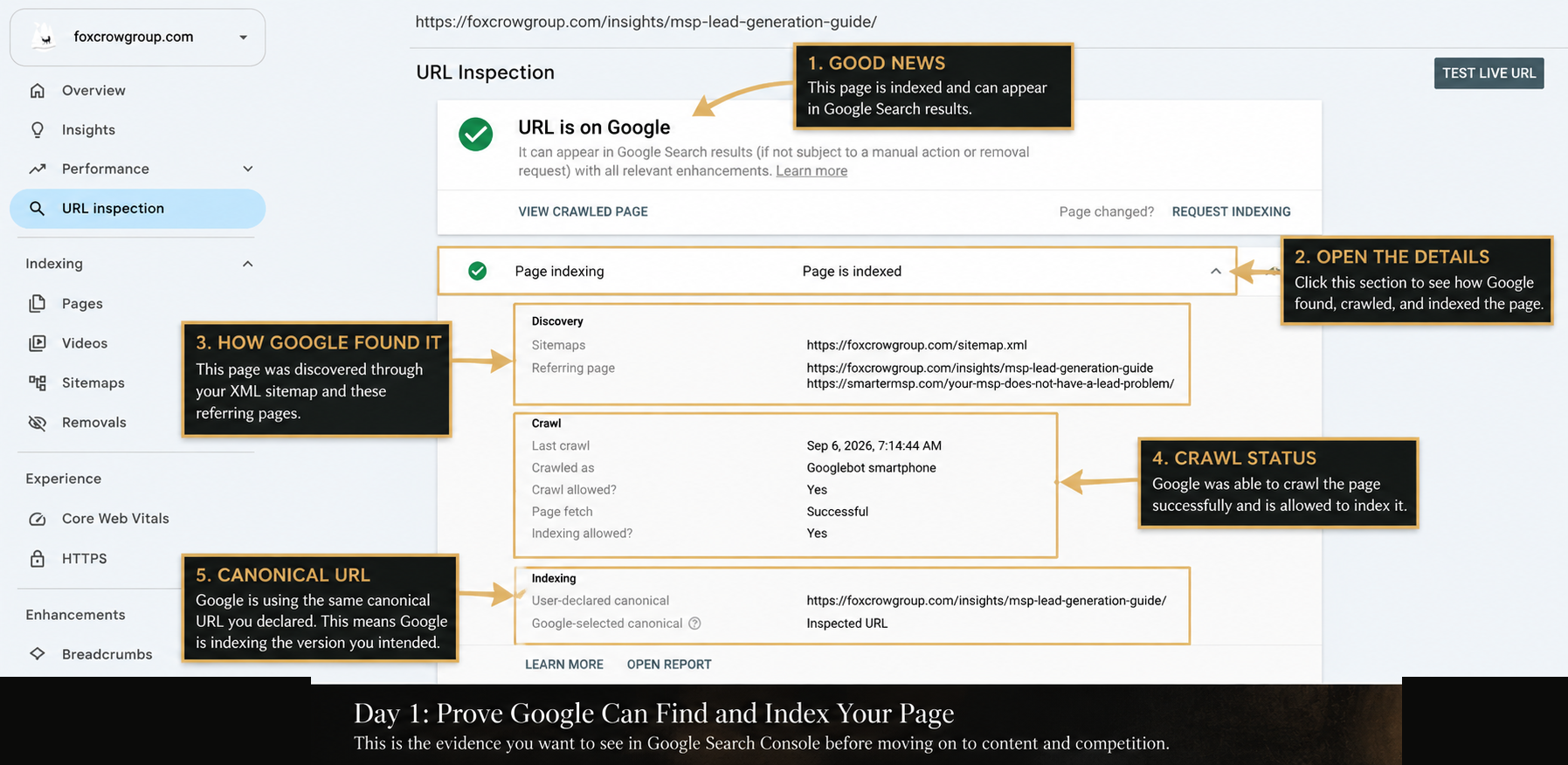
In this example, the page was found through our sitemap and referring pages. Googlebot was allowed to crawl it. The fetch succeeded. The page was allowed into the index, and the user-declared canonical matched the Google-selected canonical.
That is what I want to see before I spend a dollar "fixing rankings." Discovery and indexation have passed. I can move on.
What Search Console Evidence Actually Proves About an MSP Website
See exactly what each Search Console field proves
| Search Console evidence in this example | Result | Owner-level interpretation |
|---|---|---|
| URL status | URL is on Google | Google reports the inspected URL as indexed |
| Page indexing | Page is indexed | The indexation gate has passed |
| Discovery | Sitemap plus referring page | Google had more than one path to the URL |
| Crawl agent | Googlebot smartphone | The mobile crawler fetched the page |
| Crawl allowed | Yes | Robots rules did not block the fetch |
| Page fetch | Successful | Google retrieved the page successfully |
| Indexing allowed | Yes | The page did not tell Google to exclude it |
| User-declared canonical | The inspected page URL | The site named the intended version |
| Google-selected canonical | Inspected URL | Google's selected version matched ours |
| Last crawl in the captured evidence | September 6, 2026 at 7:14:44 AM | We have a dated crawl event, not a vague claim that Google "knows about" the page |
The important result is not the number of green checks. It is that the evidence lets me rule out a class of problems. I can stop spending time on "Can Google use this URL?" and move to "Should this page win the search?"
This is what a useful technical check does: it removes possibilities. I do not need the report to tell me the entire SEO strategy. I need it to tell me whether the first gate passed.
If Search Console shows the page is indexed, crawling is allowed, the fetch succeeded, and the canonical is the URL I intended, I have enough evidence to move on. If one of those things is wrong, the next step is narrower. Fix that issue, ask Google to process the page again where appropriate, and retest before you start rewriting content or buying links.
What a canonical mismatch can mean without the jargon
Imagine you have two URLs that contain nearly the same content. Your site may declare one of them as the main version. Google can still select another version if the surrounding signals point somewhere else.
That does not automatically mean disaster. It does mean I want an explanation when the page I expect to rank is not the page Google considers primary.
Common reasons include duplicate or near-duplicate pages, inconsistent internal links, redirects, tracking parameters, old URLs that remain linked, or a template that generates multiple versions of the same content.
The owner-level question is simple: Which URL are we trying to rank, and does the site consistently treat that URL as the primary version?
Why an MSP Website Page Can Exist and Still Be Absent From Google
A published page only proves that your CMS can display it. Search engines still need a clean path to it.
A page can stay out of the index because it is blocked, marked noindex, redirected, canonicalized to another URL, isolated from the rest of the site, duplicated heavily enough that another version is selected, or simply not considered useful enough to retain in the index. Those are very different problems.
This is also why site navigation matters. A money page linked prominently on relevant pages gives crawlers repeated discovery paths and gives the site a clearer internal signal that the page matters. A page buried five clicks deep, linked once from an old blog post, and missing from the sitemap is asking for trouble.
If you launch a new service-area page and it does not appear immediately, do not start rewriting it every morning. First confirm that Google has actually crawled it and whether the page is indexed. You cannot diagnose a ranking problem before you know the page is eligible to rank.
Day 1: exact free-tool steps
Open Google Search Console. Use URL Inspection on the exact page you chose. Record whether the URL is indexed.
Open the indexing details and check:
- crawl allowed;
- page fetch successful;
- indexing allowed;
- referring page or sitemap discovery;
- user-declared canonical;
- Google-selected canonical;
- last crawl date.
If the page is excluded, record the reason before anybody changes the site. A redirect, noindex, duplicate/canonical issue, and crawl failure require different fixes.
A Google site: search is useful as a rough public check. It is not the source of truth for your own index status. Use Search Console for that.
You are done for Day 1 when you can say: "Google can index this exact page," or "Google cannot index this exact page, and here is the reason currently reported."
Day 2: Does Your MSP Website Page Deserve the Search?
Indexation earns you the right to compete. It does not make the page competitive.
This is where I stop looking at tools for a minute and read the page like the person I expect to buy from us.
MSP Search Intent Is the Buyer's Question, Not Your Keyword List
An MSP owner can publish a technically perfect article that has almost no chance of producing useful demand because the subject does not match what an executive buyer is trying to solve.
Look at this example.
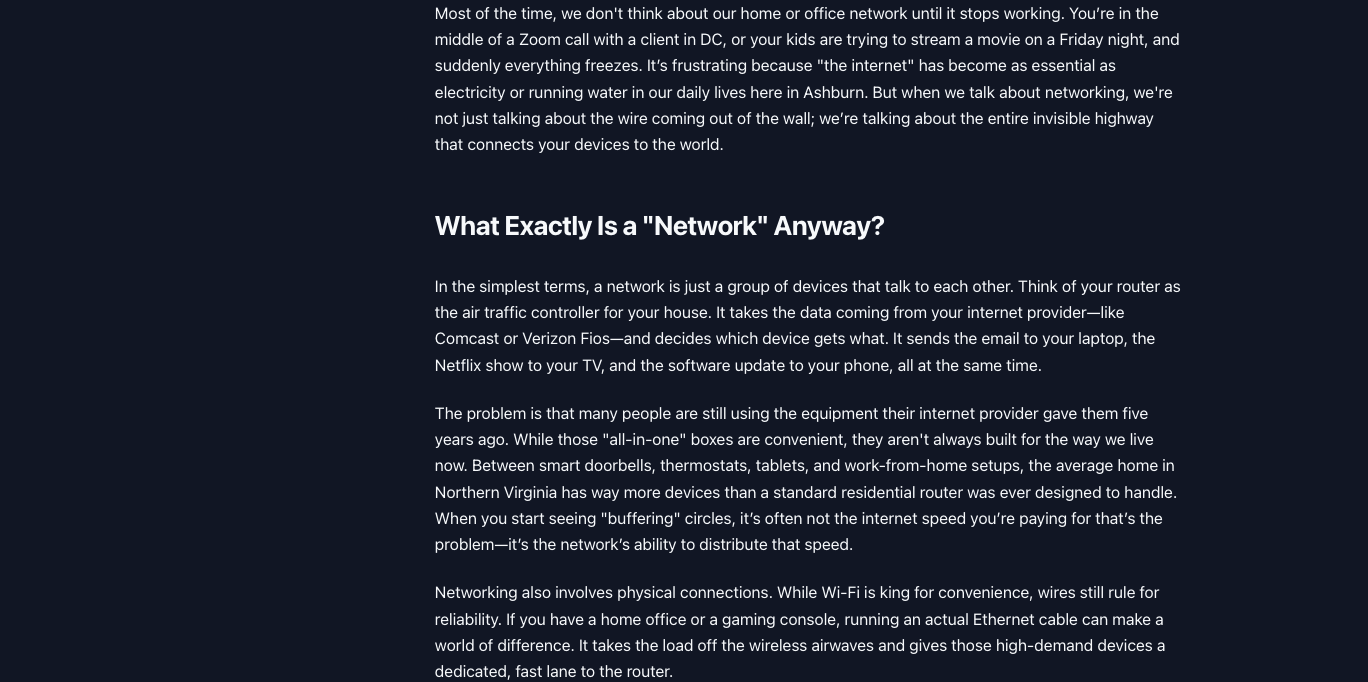
The article explains what a network is using familiar analogies: the router is an air traffic controller, the network is a highway, and Ethernet is the fast lane. The writing is readable and localized. The problem is the level of the lesson; it is teaching somebody who does not know what a network is.
Ask the commercial question: is that what the CEO of a 40-person company is searching before replacing an IT provider?
Probably not.
That buyer is more likely to search around a business symptom or decision: why the office Wi-Fi keeps dropping, why performance stayed bad after a bandwidth upgrade, what causes repeated network outages, whether the current provider should have caught the problem, what replacement will cost, or what questions to ask the MSP that keeps blaming the ISP.
The difference is not sophistication for its own sake. The buyer has a job to do. Content that meets the buyer at the wrong level can be perfectly written and commercially useless.
This is what people mean by search intent. It is the job behind the query.
Two people can use almost the same words and need completely different answers. Someone searching "network definition" may be learning a basic concept. Someone searching "why does our office network keep dropping" has a live business problem. The second person is closer to a provider decision, and the page has to respond accordingly.
Keyword tools are good at producing phrases. They are much less useful when the owner treats the phrase itself as the strategy. The page has to understand the person behind the phrase.
If "search intent" is new, use this test
Read the query and ask what the person is trying to accomplish immediately after the search.
Are they trying to learn a definition? Compare providers? Estimate cost? Diagnose a failure? Build a shortlist? Decide whether the current provider is doing a competent job?
Then read the page and ask whether it helps with that job.
A page can contain the exact keyword ten times and still miss the intent. A page can use the phrase only a few times and answer the buyer perfectly. Search engines have become very good at matching meaning, which is why keyword density is such a weak substitute for useful content.
For an MSP owner, this also protects you from content that is "SEO optimized" on paper but aimed at people who were never likely to buy anything.
The MSP Search-Intent Mismatch in One Table
| Weak page answers | Executive buyer is trying to solve |
|---|---|
| What is a network? | Why does our office network keep failing? |
| What does a router do? | Why did a bandwidth upgrade fail to solve performance? |
| Ethernet is the "fast lane" | What is causing the repeated outage and who owns the fix? |
| Networking basics | Should my current provider have caught this? |
| Generic local reference | What should I ask before replacing the provider? |
That difference matters for SEO because Google ranks pages against searches, not against a publisher's editorial calendar. It matters for AIO because a useful answer engine needs a specific statement it can lift into an answer. A beginner analogy rarely helps an executive make the next decision.
Generic AI Copy Fails MSP Websites by Sounding Complete Without Containing Experience
The same networking article has another problem. It reads like AI-assisted content. I cannot prove which tool wrote it, whether a human drafted it, or how much editing happened. I can show you the patterns.
The opening manufactures a relatable scene, stacks a series of metaphors, and settles into a long basic definition. The prose is smooth, safe, and orderly. Swap the city name and the operating advice barely changes.
I use AI. I am not interested in pretending the machine is the moral problem. The problem is charging an MSP for content that looks like the first useful draft a general-purpose model could produce without somebody inside the company teaching it anything.
Here is the test I use:
What does this page contain that an AI model could not have produced without someone from our company teaching it something?
If the answer is "nothing," you have not demonstrated much expertise.
The point is not to make every paragraph sound exotic. Most expert content still explains ordinary things. The difference is what happens when the obvious explanation runs out.
An experienced operator knows where the process breaks, what order matters, which shortcut creates risk, which question exposes a weak provider, and which answer sounds good until you have lived through the consequence. That is the material generic AI cannot invent responsibly without being taught.
For AIO, that specificity matters because answer engines need something discrete enough to quote or summarize. "Cybersecurity is important" is useless. "Call the carrier before your provider begins an investigation because the policy may control how incident response is handled" contains an action, an order, and a reason.
What makes a passage easy for an AI answer engine to use?
You do not need to write for robots. Write sentences that stand on their own and contain real information.
Strong passages usually have one or more of these characteristics:
- a direct answer to a natural-language question;
- a clear definition;
- an ordered process where sequence matters;
- a comparison with a stated reason;
- a supported number with context;
- a cause-and-effect explanation;
- a specific risk or tradeoff;
- a practitioner judgment that explains why.
Tables help because they make relationships explicit. Headings help because they tell both people and machines what the section is about. Lists help when the content is genuinely sequential or categorical.
None of that rescues thin thinking. Structure makes good information easier to extract. It does not manufacture expertise.
See the AI-content tells I use when reviewing a page
| Content signal | What it tells me |
|---|---|
| Generic relatable opening | The writer is warming up instead of solving the buyer's problem |
| Stacked metaphors | The page is explaining basics rather than showing operator judgment |
| City name that can be swapped without changing the advice | Localization has been bolted on instead of earned through local knowledge |
| No consequence, tradeoff, sequence, or decision | The page gives an answer engine very little worth quoting |
| Specific order of operations | Somebody had to decide what happens first and why |
| Supported numbers, evidence, or observed failure modes | The page contains material that can be checked |
| A clear point of view about risk and accountability | The reader learns how an experienced operator would make the decision |
The first bad case-study example has the opposite shape. It hints that expertise exists, then hides the substance behind a form.
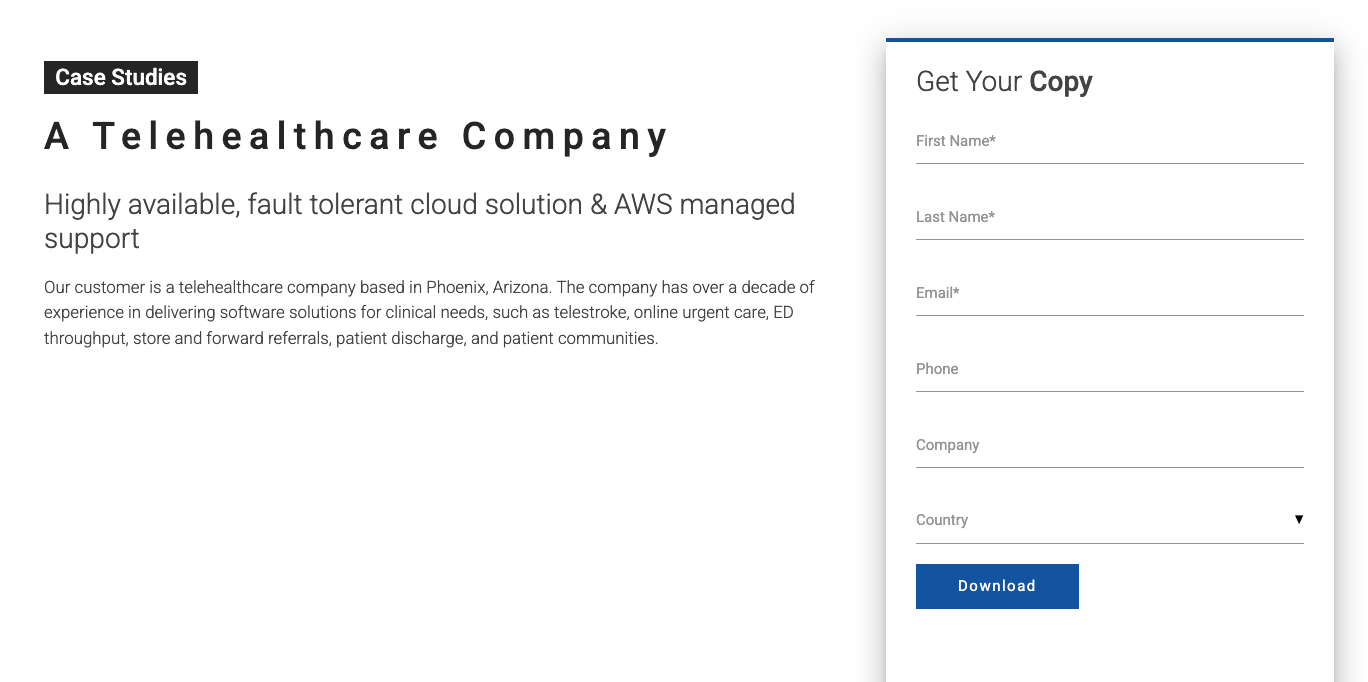
The headline identifies the customer type, the subhead describes the service, and the visible copy gives some background before the page asks for information to "get your copy."
What is missing from the public page? A clear problem, a measurable before-and-after, a decision, a tradeoff, a consequence, or enough proof to make the reader care about the download.
A gated PDF can be valuable. Hiding all the useful material behind the gate leaves the crawlable page thin and gives an AI answer engine very little to quote.
Good MSP Website Content Shows Expertise as Judgment
Now compare those examples with a page that tells an executive what to do after a security incident.
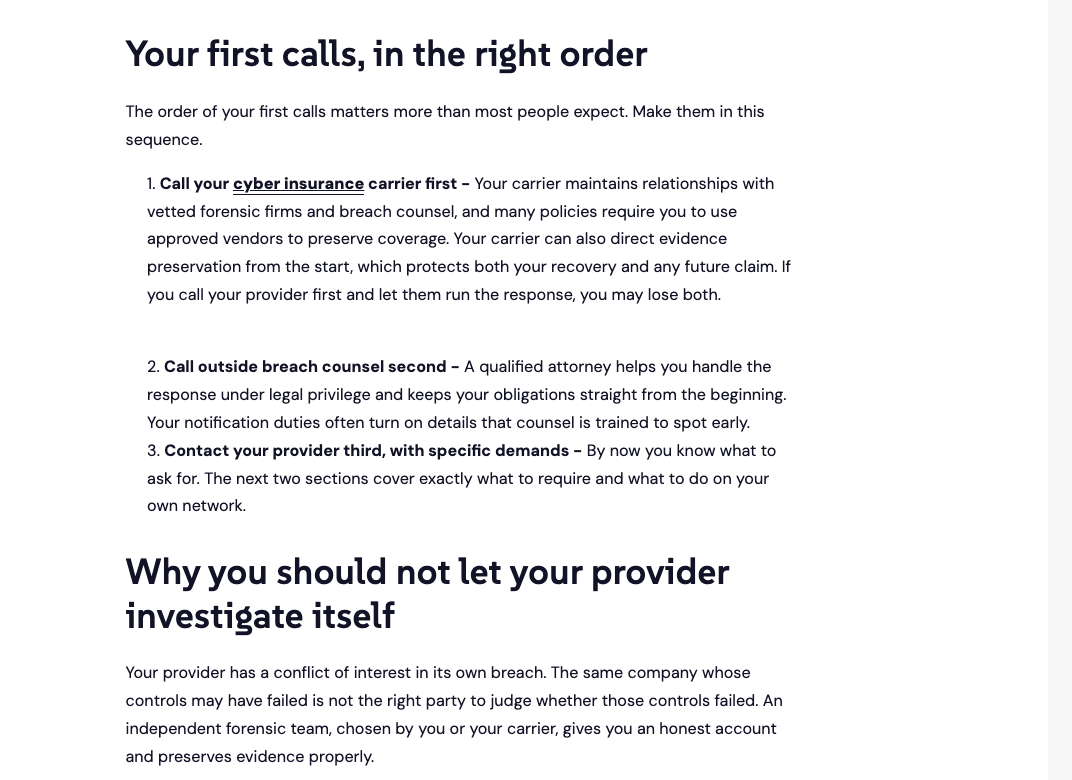
The section tells the reader who to call first, who to call second, and what to demand from the provider. It explains why cyber-insurance requirements matter, why breach counsel matters, why evidence preservation matters, and why asking the current provider to investigate itself can create a conflict.
That content does not prove expertise by throwing technical vocabulary at the reader. It helps the buyer make a better decision.
That is also what makes it useful to search engines and AI answer systems. A sentence explaining the sequence of calls after an incident is easy to extract because it contains an actual decision. A paragraph about "leveraging innovative technology solutions to empower your business" contains nothing worth citing.
GOOD MSP Content and BAD MSP Content Are Different for a Reason
| Test | Bad gated case study | Bad network-definition article | Good breach-response section |
|---|---|---|---|
| Buyer problem is visible | Weakly | Weakly | Yes |
| Useful answer appears before a gate | No | Yes, but at the wrong level | Yes |
| Practitioner judgment | Little visible proof | Little | Strong |
| Decision sequence | No | No | Yes |
| Consequence or risk | Barely visible | Generic | Specific |
| Company-specific knowledge | Hard to verify publicly | Easy to swap onto another MSP site | Clear operating judgment |
| Quotable by an AI answer engine | Limited public material | Generic definitions | Strong, specific instructions |
| Helps the buyer make a better decision | Not enough visible evidence | Rarely | Yes |
Good copy helps the buyer make a better decision. Bad copy proves somebody fulfilled the "publish a blog post" line item.
Day 2: run the content test
Write the buyer question at the top of the page.
Read the H1, deck, and first 200 words. Did the page answer the question, or did it spend the opening warming up?
Then mark:
- text that could appear on another MSP site unchanged;
- unsupported adjectives and claims;
- decisions the reader can act on;
- tradeoffs or consequences;
- numbers or examples you can support;
- company-specific operating knowledge;
- sentences an AI answer engine could quote usefully.
Search a few distinctive sentences in quotation marks if you suspect templated or syndicated content.
Do not confuse geographic exclusivity with originality. An agency can sell the same article to only one MSP per city and still give every buyer substantially the same page. Geographic distribution rules do not create usefulness, originality, index value, or citation value.
You are done for Day 2 when you can point to the sections that earn trust and the sections that are merely filling space.
Day 3: Is Your MSP Website Technically Getting in Its Own Way?
Day 3 is where SEO agencies can make an MSP owner feel like they need a second career in web development. You do not.
You own an IT company. You already understand the accountability model.
If one of your technicians closed a ticket with "network optimized" and no diagnosis, no change record, and no retest, you would send it back. Apply the same standard to "technical SEO optimized."
I do not need you to learn how to rewrite JavaScript bundles or tune a database. I need you to know what the site should do and what a competent developer should be able to explain.
PageSpeed Shows How an MSP Website Page Behaves, Not Whether It Deserves the Query
I ran PageSpeed Insights on the same Fox & Crow article used in Day 1.
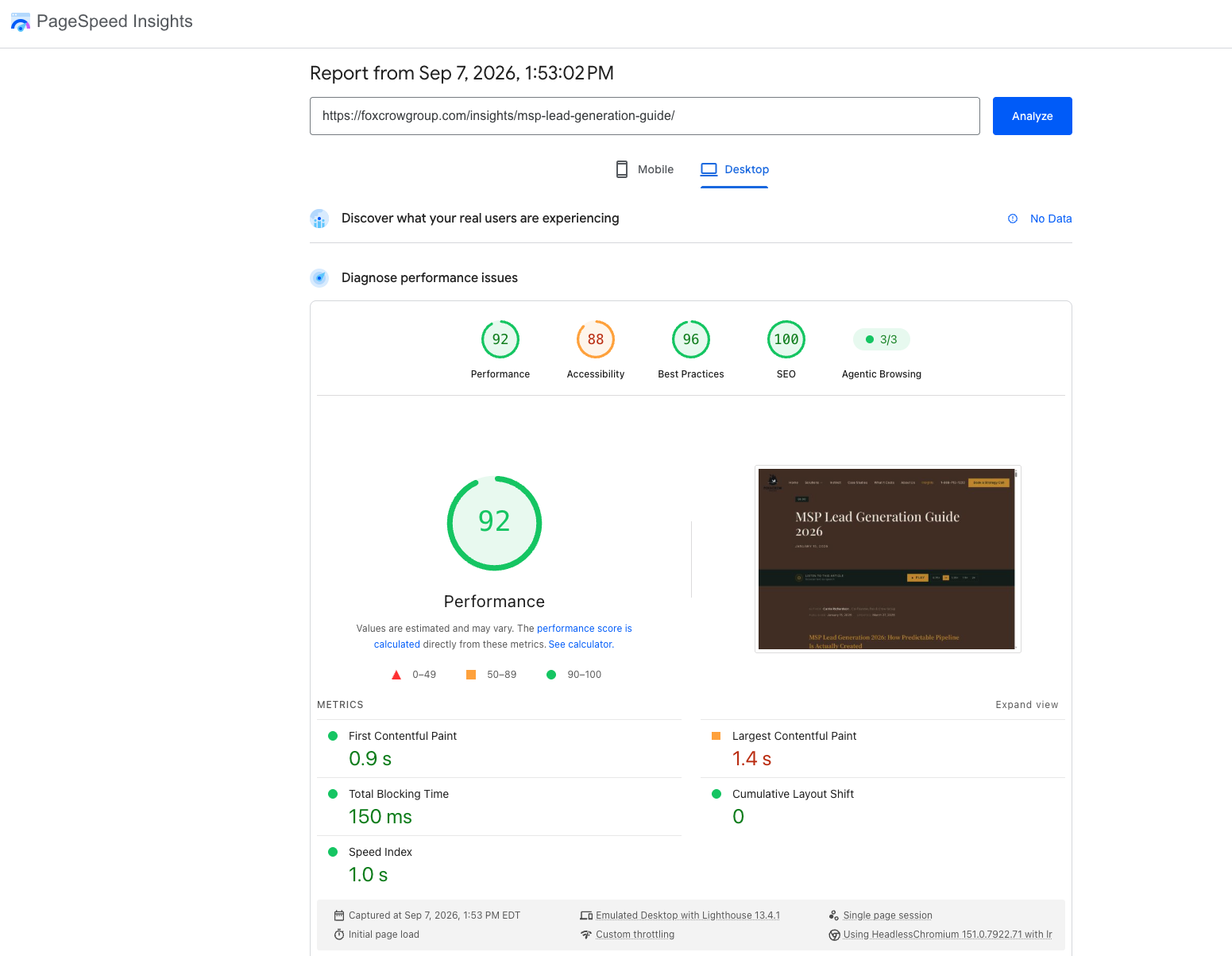
On that run, desktop Performance was 92, Accessibility 88, Best Practices 96, and the Lighthouse SEO check 100. First Contentful Paint was 0.9 seconds. Largest Contentful Paint was 1.4 seconds. Total Blocking Time was 150 milliseconds. Cumulative Layout Shift was 0.
Those numbers are evidence about that lab run. They are not revenue KPIs.
See the complete PageSpeed evidence and what each metric means
| PageSpeed evidence | Captured result | What it measures | What I ask next |
|---|---|---|---|
| Performance | 92 | Lighthouse lab performance score | Is a real user being slowed down by anything significant? |
| Accessibility | 88 | Automated accessibility checks | Which failures are actionable and who owns them? |
| Best Practices | 96 | Browser/security/implementation checks | What created the deductions? |
| SEO | 100 | Lighthouse technical checks | Good. Now stop pretending that score proves rankings. |
| FCP | 0.9 s | Time until first content is painted | Does useful content appear promptly? |
| LCP | 1.4 s | Time until the largest visible content element renders | Is the main content arriving quickly? |
| TBT | 150 ms | Main-thread blocking in the lab run | Is unnecessary browser work delaying interaction? |
| CLS | 0 | Visual movement during load | Is the page stable while somebody reads or clicks? |
| Real-user field data | No Data in this report | Whether enough field data was available for this URL | Do not translate "No Data" into "failed" |
What matters to me is whether useful content appears quickly, the page stays put while somebody tries to click, and the browser responds when a visitor uses it. I also want obvious accessibility or implementation problems exposed clearly enough that somebody can own the fix.
I do not care about turning a 92 into a 97 just so a monthly report has something green to celebrate.
If you have never looked at a PageSpeed report, the acronyms make the screen look more complicated than the underlying questions. Does the page show useful content quickly? Does the biggest thing the visitor is waiting for arrive promptly? Can the browser respond when the visitor tries to use the page? Does the layout stay still long enough to click and read?
That is what I care about as the owner. A developer may need the technical detail. I need to know whether a real person is being punished for trying to use the page and whether the fix is worth prioritizing.
PageSpeed terms in normal language
| Term | Plain-English meaning | What bad performance feels like |
|---|---|---|
| FCP — First Contentful Paint | The browser puts the first useful thing on the screen | Staring at a blank page before anything appears |
| LCP — Largest Contentful Paint | The largest major visible element finishes rendering | The page looks half-loaded while the main content catches up |
| TBT — Total Blocking Time | Browser work delays interaction during the lab test | The page looks loaded but clicks and taps feel stuck |
| CLS — Cumulative Layout Shift | The layout moves while the page is loading | A button or link jumps just as you try to click it |
The Lighthouse SEO score checks a limited set of technical items. A 100 does not mean "this page should rank first." It means those particular automated checks passed.
The report also showed No Data under real-user experience for the URL. That is not a failure score. It means field data was not available or displayed for that URL in that report. The rest of the screen is lab data from the test run.
For Fox & Crow, I cannot call another agency and ask why the site is slow. I built it. I maintain it. If Accessibility is 88, I know exactly whose list it goes on.
MSP Google Maps Visibility Is Separate From Organic Website Ranking
Now look at a different surface.
I searched for a service we sell plus our city. Fox & Crow was the first local result shown in Google Maps for that search.
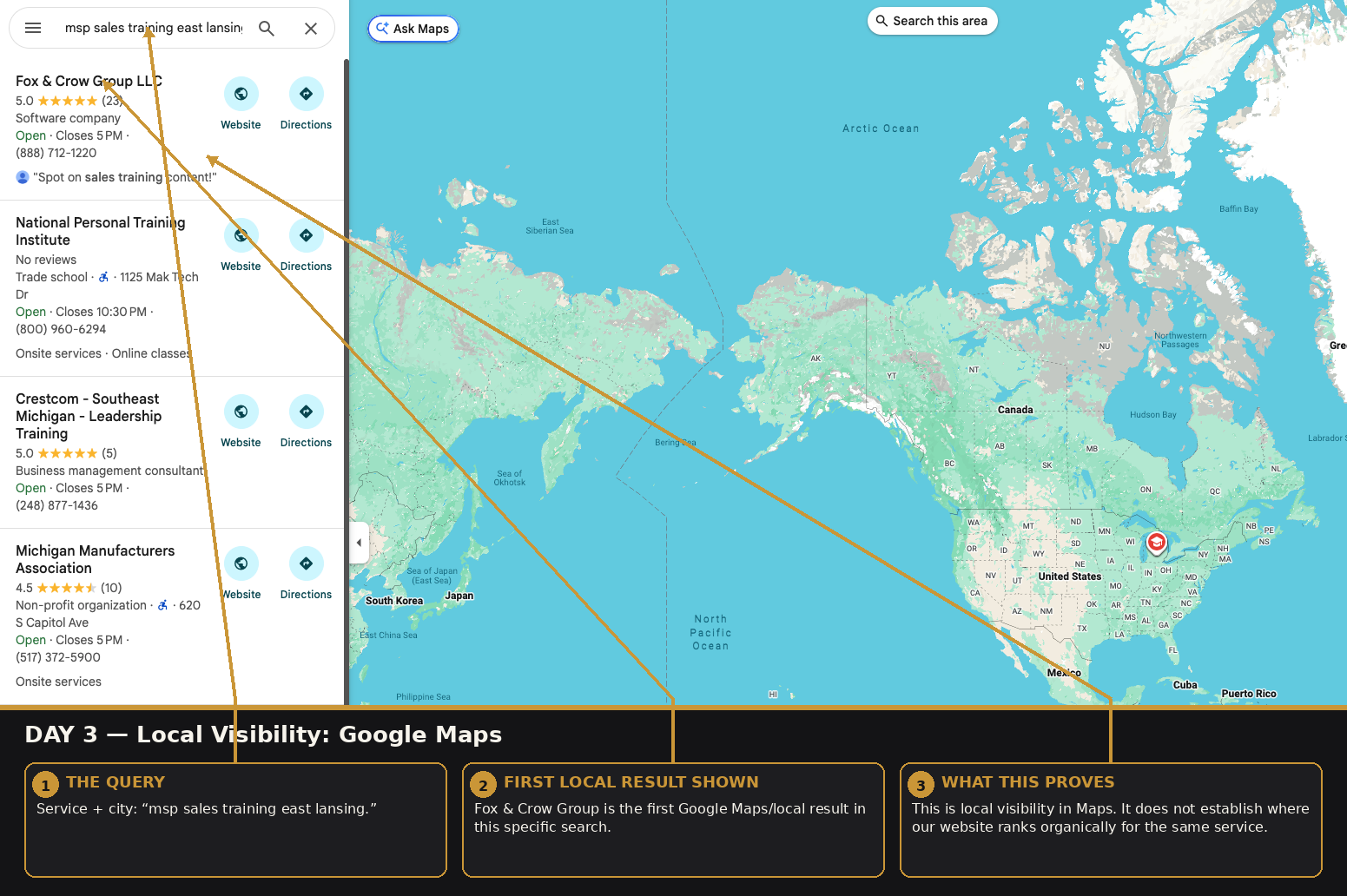
I like that result. I am still not going to write "Fox & Crow ranks #1 on Google" based on it.
Maps/local visibility and organic website ranking are different result systems. Your Google Business Profile can perform well while your service page barely appears organically. The reverse can also happen.
This matters because "visibility increased" is useless reporting unless the report names the surface. Maps? Organic? Paid? AI citation? Branded searches? Non-branded searches?
If the report blends all of them into one percentage, you may be looking at a number designed to be hard to challenge.
| Search surface | What a win proves | What it does not prove |
|---|---|---|
| Google Maps / local results | The Business Profile appeared prominently for that local search context | The website holds the same organic position |
| Organic website result | A page from the site ranked in the organic listings | The Business Profile is competitive in Maps |
| Paid result | An ad was shown for the query | Organic visibility improved |
| AI Overview citation | The source was cited in that generated answer at that moment | Permanent AI visibility or visibility in other AI systems |
| Branded search | People who already know the company can find it | New buyers discover the company for a non-branded problem |
Keep those numbers separate. Blended visibility makes weak areas harder to see.
This distinction matters because owners are often shown one cheerful graph labeled "visibility." That graph can combine branded searches, Maps appearances, organic results, paid ads, and other surfaces until the number becomes almost impossible to interpret.
I want the channels separated because each one answers a different business question. If Maps is strong and organic is weak, that tells me where the next investigation belongs. If branded search is strong but non-branded discovery is weak, I know people who already know the company can find it while new buyers are still missing it.
Maps, organic, paid, and branded search: the quick version
Maps / local results are the business listings shown for local-intent searches. They rely heavily on the Google Business Profile and local relevance signals.
Organic results are the ordinary unpaid website pages in the search results.
Paid results are advertisements. They can be useful, but buying an ad does not improve the organic position underneath it.
A branded query includes your company or product name. A non-branded query describes the problem, service, category, or location without naming you.
For growth, non-branded visibility is especially useful because it shows whether people who do not already know your company can discover you.
An MSP Website Crawl Turns Technical SEO Into Answerable Questions
The Screaming Frog interface looks intimidating because it exposes a lot of the machinery at once.
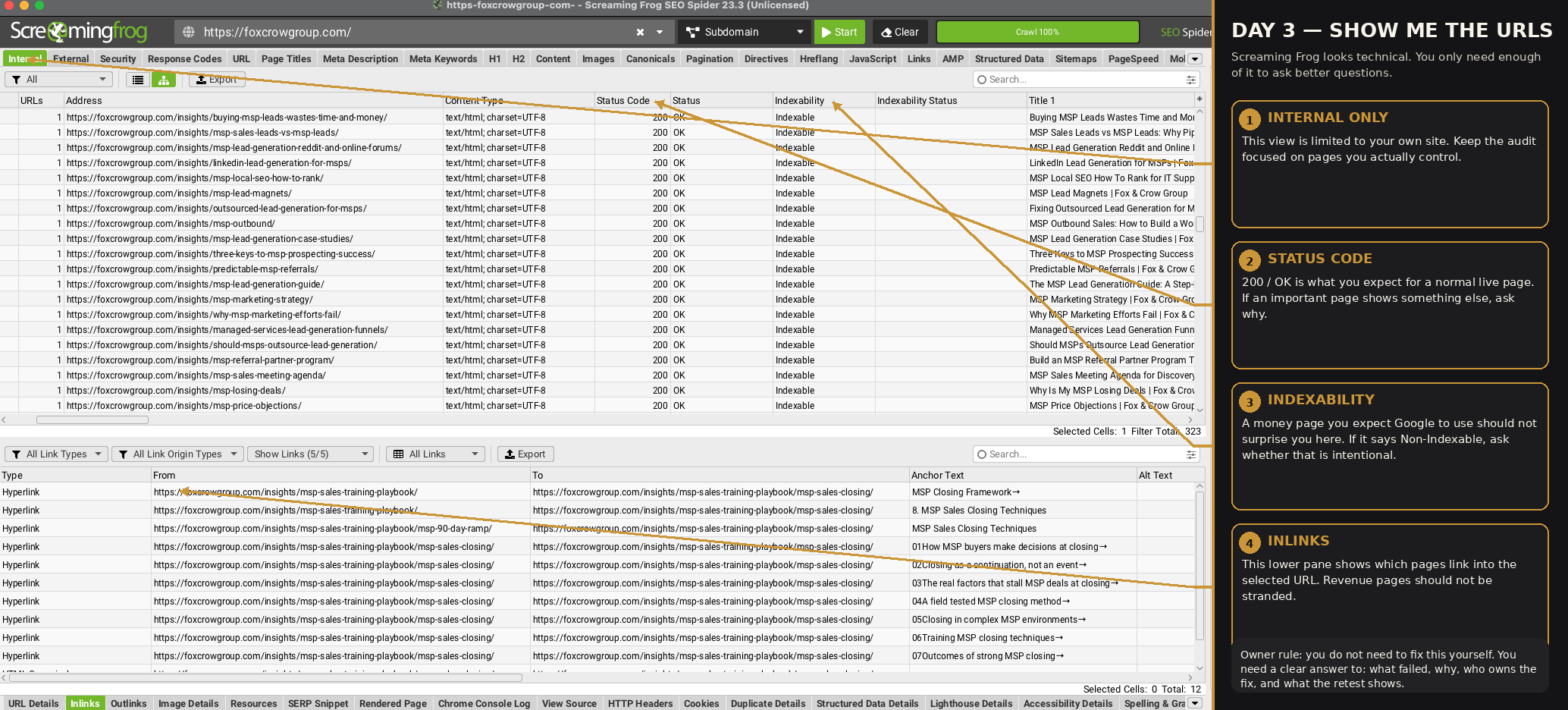
You do not need to understand the entire interface. Filter to your own internal URLs and find the page you care about.
A normal live HTML page you expect to rank will usually return 200 OK. A redirect should have an intentional destination. A non-indexable revenue page needs an explanation. A canonical pointing somewhere else means you need to confirm which URL is supposed to rank. And when a money page has almost no internal links, ask why the rest of the site barely connects to it.
Redirects, canonicals, and lower scores can all be legitimate. The problem is nobody being able to explain why the configuration exists.
Translate the MSP Website Crawl Into Owner Questions
Translate the Screaming Frog crawl into owner questions
| Crawl field | Healthy-looking result for a revenue page | Question when it looks wrong |
|---|---|---|
| Status code | Usually 200 for the live HTML page you expect to rank | Why is this redirecting or failing? |
| Indexability | Indexable when the page should appear in search | Why is this page excluded? |
| Canonical | The intended ranking URL | Why are we telling Google another URL is primary? |
| Redirect target | Intentional destination | Why does our own site still link to the old URL? |
| Inlinks | Enough relevant internal paths to make the page easy to reach | Why is a revenue page barely linked from the rest of the site? |
| Content type | HTML for the page body | Is the substantive article actually present in the server response? |
You are not trying to become the developer. You are replacing "technical SEO was optimized" with questions that have verifiable answers.
The words in the crawl report sound technical because they describe how websites behave under the hood. The owner decision is usually much simpler. Is this page live? Is it allowed into search? Are we sending Google somewhere else? Can people and crawlers reach it through the site? Is the actual article present in the HTML that comes back from the server?
That last question matters more than it used to. A page can look fine in a browser after JavaScript runs and still return very little useful article content in the raw response. For this post, that would be a build failure. Search engines are much better at rendering modern sites than they were years ago, but I still want substantive content available in the server-delivered HTML rather than betting the article on client-side assembly.
Screaming Frog terms without the spider costume
A status code is the server's response. 200 means the page loaded successfully. A 3xx response is a redirect. 4xx responses usually indicate a missing or inaccessible page. 5xx responses indicate a server problem.
Indexability is whether the page is allowed to be indexed based on the signals the crawler can see.
A canonical tells search engines which version of similar content is intended as primary.
Inlinks are links on other pages of your own site that point at the page you are auditing. If a service page matters to the business and almost nothing on the site links to it, I want to know why.
A redirect sends visitors and crawlers to a different URL. Redirects are normal when they are intentional. Old internal links that keep sending everyone through unnecessary redirects are just housekeeping nobody finished.
You do not need to fix these yourself. You need to recognize the words well enough to ask for an explanation that makes sense.
Day 3: questions for the person who owns the website
For any failed or suspicious result, ask:
- Which exact URL is affected?
- What caused the result?
- Is it one page, one template, or the whole site?
- Is the behavior intentional?
- What are you changing?
- Which metric or status should improve after the change?
- Can you rerun the same test and show the before-and-after result?
Use PageSpeed Insights for performance evidence, Screaming Frog's free version for a crawl of your own site, and Search Console for indexation. Keep the tools in their lanes.
You are done for Day 3 when a technical problem can be stated as a URL, a failure, an owner, a proposed fix, and a retest.
Day 4: Which MSP Competitors Keep Showing Up Instead?
At this point, you have ruled in or ruled out three large classes of failure: indexation, page/query fit, and obvious technical problems.
Now the question changes.
If Google can use your page and the page is genuinely useful, who is occupying the searches you expected to win?
This is where the word authority usually enters the conversation, and it is one of the easiest SEO words to abuse. Authority is not a single magic score Google hands to your website. It is shorthand people use for the evidence that a site or page has earned trust around a subject: relevant outside references, useful content, internal support, a history of being selected for related searches, and other signals search engines can observe.
Backlinks are part of that story. The word simply means another website links to yours. A relevant editorial link can help discovery and can act as third-party evidence that another site considered your page worth referencing. Manufactured placements and low-value directory links do not carry the same meaning.
I am keeping the link discussion intentionally shallow here because the next posts in this series go much deeper into how links are valued and how to tell a useful one from wasted effort. For this audit, the job is to identify whether outside trust appears to be part of the gap before somebody sells you a backlink package.
What "authority" means when somebody puts it in an SEO report
Ask what the number is actually measuring.
Many SEO tools create their own authority or domain-strength scores. Those can be useful for comparison inside that tool. They are not a Google-issued grade, and a lower third-party score does not prove why a competitor outranks you.
For an owner, I would rather see the underlying evidence: which relevant sites link to us, which pages earn those references, which competitors keep appearing for the same searches, and whether our visibility across the tracked set is improving.
The score can summarize. The evidence should still be available underneath it.
This is where a lot of owners reach for a paid SEO suite. You can do the basic work manually first.
Use Each MSP Competitive Evidence Source for the Question It Can Actually Answer
See which search tool answers which question
| Evidence source | Good question for it | Do not use it to claim |
|---|---|---|
| Search Console | Is my page indexed? Which queries/pages earn impressions and clicks? Which links does Google report for my site? | Why a competitor outranks me in one tidy sentence |
| Google organic results | Who appears for this exact query right now? | A stable monthly competitive trend from one search |
| Google Maps | Which local businesses appear in this location context? | Organic website rank |
| Google AI Overview | Was my page visibly cited in this answer? | Permanent visibility across AI systems |
| Instinct | Who appears across a broad MSP-market search view? | A current claim when the stored result is stale |
| Magpie | How does Fox & Crow's tracked competitive set change over time? | An MSP customer's rankings |
| Jackdaw | Which competitors and searches matter to the specific MSP customer? | SEO fixes, content production, listings management, or link building |
| ChatGPT / Claude | What can I conclude from evidence I supply? | Dependable rank tracking when the product does not expose it |
Links Are Evidence of Trust in an MSP Website, Not a Shopping List
Search Console can show external links Google reports for your own site. Use that as evidence, not as an instruction to buy 100 links.
A page can rank without backlinks, especially for lower-competition searches. A page competing against established local or industry resources may need stronger third-party evidence. The number alone does not tell you the answer.
This article deliberately stops there because the next posts in this campaign cover how links are valued, what makes a good link, and which link-building tactics waste money. I do not want to turn every SEO diagnosis into "buy backlinks." That is how owners end up paying for directories and placements before anybody proves authority is the constraint.
MSP AI Citation Visibility Is Useful When the Platform Exposes the Citation
I ran a non-branded Google search for "msp sales training." Google's AI Overview cited Fox & Crow content in the result.
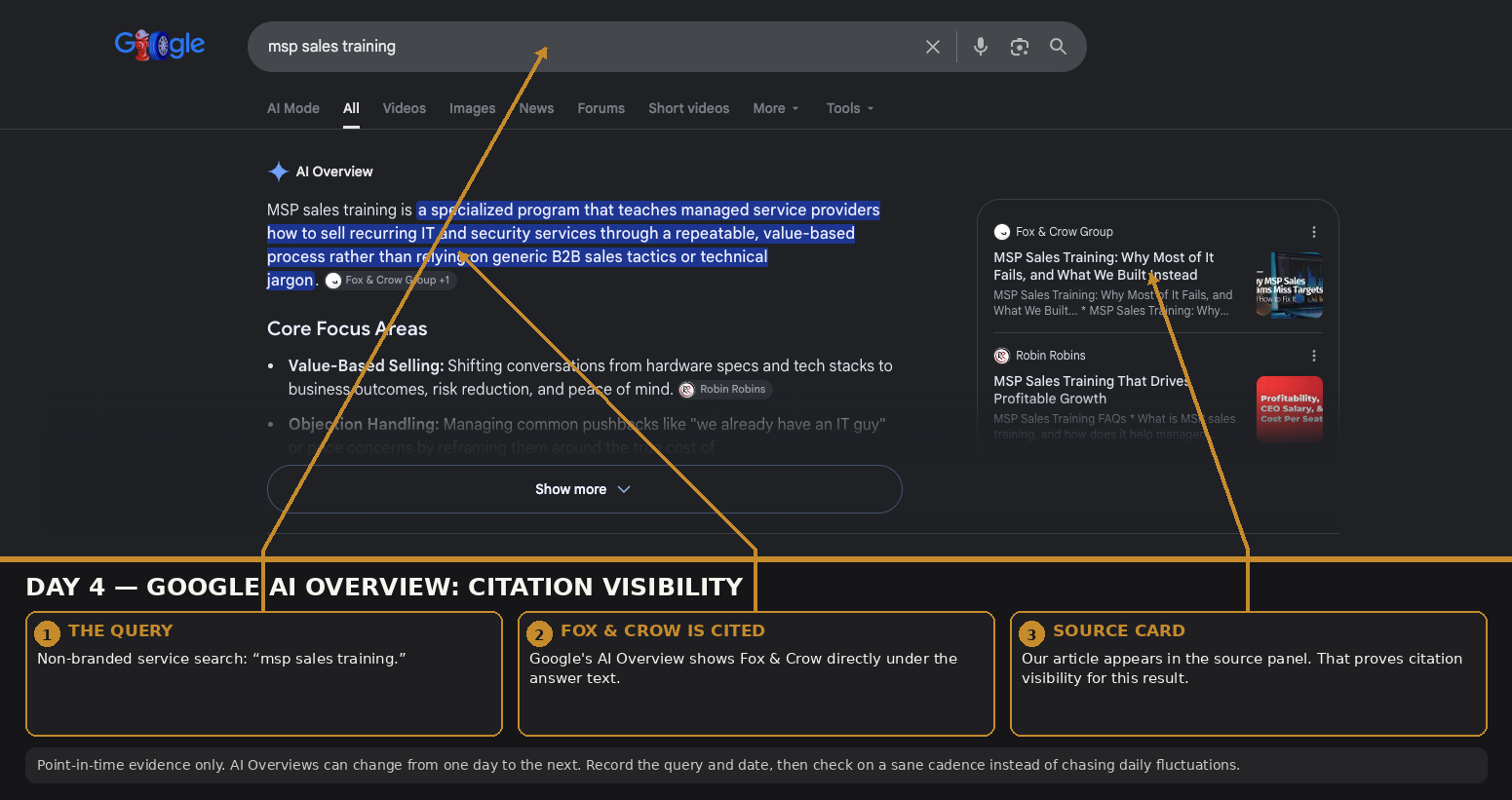
That screenshot proves something narrow and useful: in that search, on that date, Google's AI Overview exposed Fox & Crow as a cited source.
An AI Overview citation is useful because the source is visible. I can take a screenshot, record the query and date, and point to the page Google cited. That gives me something concrete.
What I refuse to do is turn that one citation into a claim that "we rank #1 in AI" or that our content now has permanent AI visibility. Generated answers change. Sources change. Different users can see different results. The honest claim is narrower: for this query, in this captured result, Google cited this page.
What AIO visibility actually means
AIO here means AI optimization: making useful, well-structured, evidence-rich content easier for AI answer systems to understand and cite when they choose sources.
There is no separate secret copywriting language for AI. The useful work overlaps heavily with good search and good editorial practice: direct answers, clear headings, explicit relationships, supported evidence, original expertise, accessible HTML, and enough context that a passage still makes sense when quoted away from the page.
The measurement problem is harder. Different AI products expose different source and ranking behavior. When a platform gives you a visible citation, record it. When it does not, do not invent a rank just because someone wants a dashboard.
The screenshot proves a citation in that captured result. It does not establish permanent AI visibility, a universal result for every searcher, equivalent visibility in ChatGPT or Claude, or the same Google sources tomorrow.
Search results move. Maps results move with location and context. AI Overviews can appear, disappear, or cite different sources. A daily check would be insane.
Pick a small set of buyer questions. Keep the wording consistent. Record the date and conditions. Check monthly, or after a meaningful change. You are looking for a pattern, not trying to win Tuesday.
I also do not force ChatGPT or Claude to produce provider lists so I can pretend they are rank trackers. We use paid team instances of both. In our environment, these prompts do not give us a dependable list of named providers to score. Fine. I use those systems to analyze evidence when I have evidence to give them.
One MSP SERP Shows Competitors; a Tracked Set Shows the Competitive Pattern
Fox & Crow Instinct gives us broad MSP market intelligence. It covers the full MSP database we maintain, about 110,000 businesses. In the example below, I used it to inspect the search "managed service provider 08701."
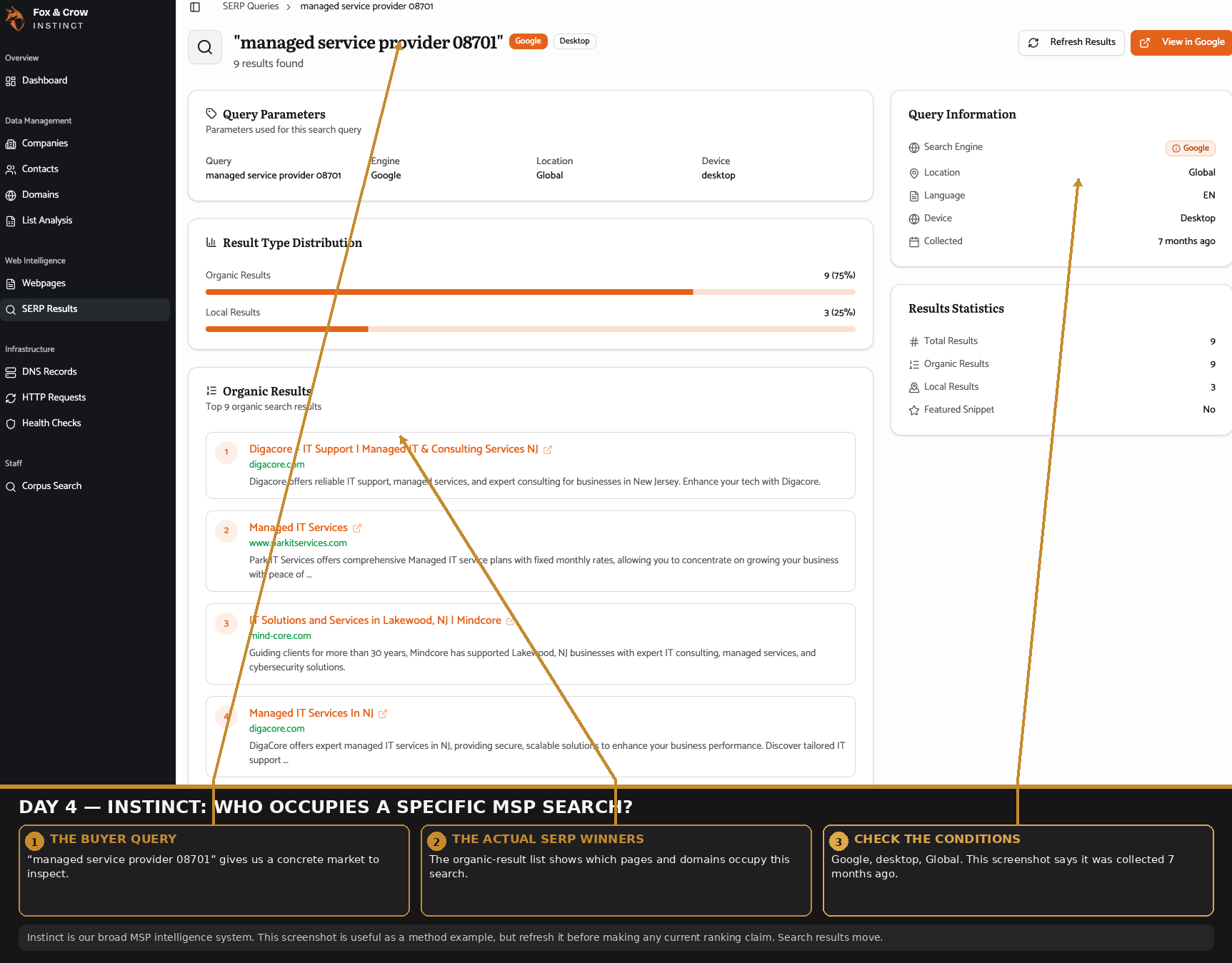
This answers a simple question: which pages occupy that specific organic search?
The screenshot also shows why you record conditions. The example says Global, Desktop, and Collected 7 months ago. I would refresh it before claiming those are today's rankings. The old screenshot still teaches the method: exact query in, actual pages out.
See the exact fields captured in the Instinct example
| Instinct field in the captured example | Evidence |
|---|---|
| Query | managed service provider 08701 |
| Search engine | |
| Location scope shown | Global |
| Device | Desktop |
| Organic results | 9, shown as 75% of the captured result types |
| Local results | 3, shown as 25% |
| Top organic pages shown | Digacore #1, Park IT #2, Mindcore #3, Digacore #4 |
| Freshness warning | Collected 7 months ago |
The freshness warning is part of the evidence. Leave it in. Old competitive data is useful for teaching the method and useless for claiming today's winner.
For Fox & Crow's own competitive work, I use Magpie, our private system built on the same technology. We do not need MSP rankings for ourselves. We track the searches tied to our own services and the companies competing for those searches.
| System | Who it is for | Scope | Job |
|---|---|---|---|
| Instinct | Fox & Crow research | Broad MSP market, about 110,000 businesses | Market discovery and research |
| Magpie | Fox & Crow internally | Our own competitors and the searches tied to our services | Private competitive intelligence |
| Jackdaw | MSP customer | Only the competitors, markets, and searches the customer actually cares about | Targeted competitive-intelligence report somebody can act on |
Jackdaw is deliberately narrower than Instinct. An MSP owner does not need a giant raw market database to answer "who keeps beating me for the searches that matter?"
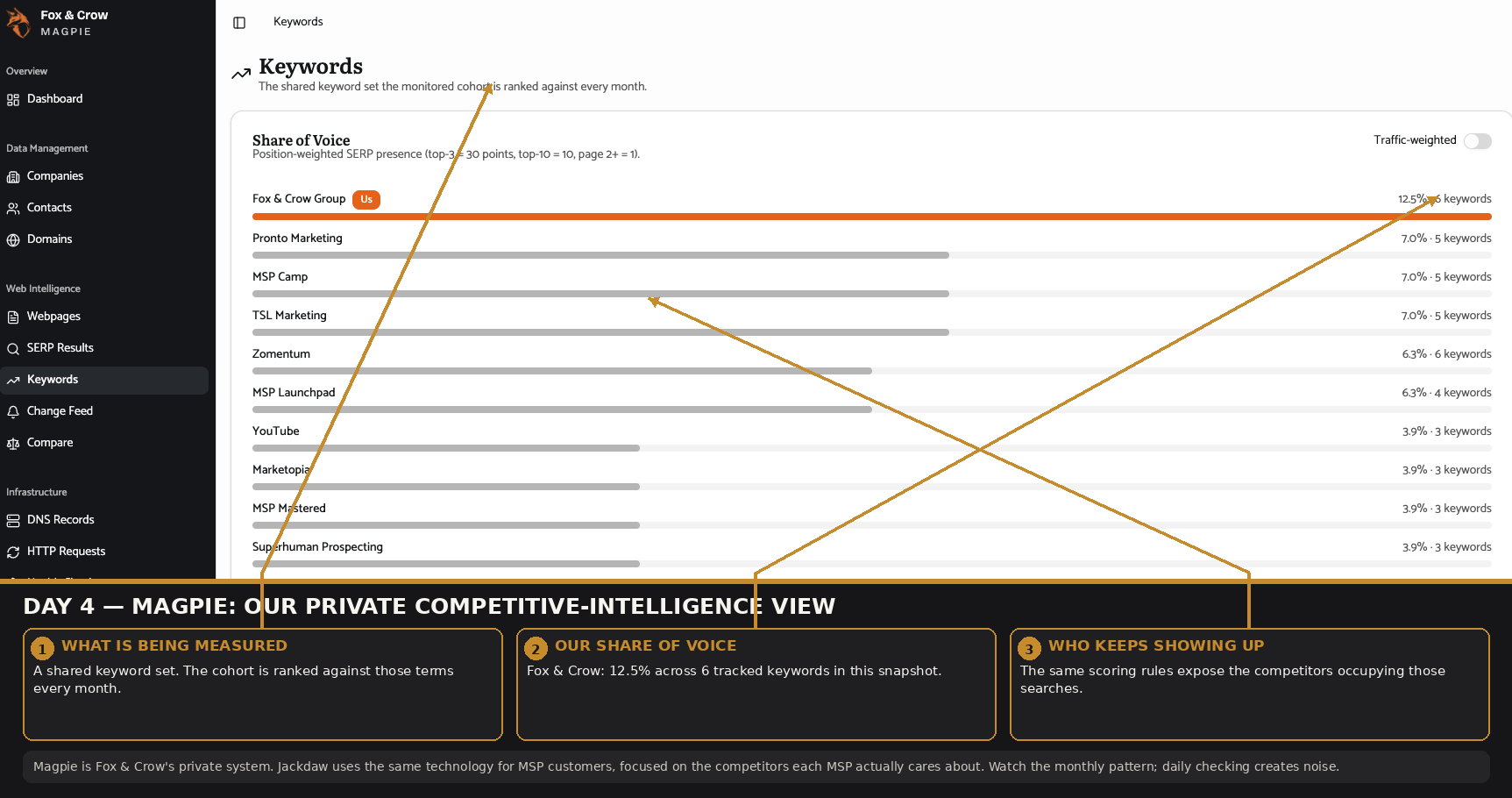
In this snapshot, Fox & Crow held 12.5% position-weighted share of voice across six tracked keywords. The interface also tells me how the score is constructed: higher ranking positions carry more weight.
The captured Magpie configuration assigns 30 points for a top-three position, 10 points for the rest of the top ten, and 1 point for page two or deeper. Traffic weighting was off in this view.
| Company / source | Position-weighted share of voice | Tracked keywords shown |
|---|---|---|
| Fox & Crow | 12.5% | 6 |
| Pronto | 7.0% | 5 |
| MSP Camp | 7.0% | 5 |
| TSL | 7.0% | 5 |
| Zomentum | 6.3% | 6 |
| MSP Launchpad | 6.3% | 4 |
| YouTube | 3.9% | 3 |
| Marketopia | 3.9% | 3 |
| MSP Mastered | 3.9% | 3 |
| Superhuman Prospecting | 3.9% | 3 |
This is the table version of the visual evidence. A person can read the screenshot; a crawler or answer engine can also extract the exact comparison without trying to infer bar lengths from an image.
If share of voice is new to you, do not overthink the name. In this context it answers: across the group of searches we chose to track, how much of the visible competitive territory are we occupying compared with the other companies that keep appearing?
Share of voice here does not mean market share or revenue share, and it says nothing about customer count. It compresses repeated search positions into one comparison so I can see whether we are gaining or losing visibility across the tracked set.
That only works when the keyword set is sensible. If I fill the tracker with easy branded terms, I can make myself look brilliant. If I track searches buyers actually use and keep the set stable, the trend becomes useful.
How this position-weighted share-of-voice score works
The Magpie view shown here gives more credit to stronger positions. In this captured configuration, a top-three position receives 30 points, the rest of the top ten receives 10 points, and a page-two-or-deeper appearance receives 1 point. Traffic weighting is off.
That means appearing near the top of several important searches contributes more than barely appearing on page two.
The exact scoring model matters less than consistency. If I change the keyword set or the weights every month, the trend becomes hard to interpret. If I keep the method stable, I can watch Fox & Crow and the competitive set move against the same yardstick.
I am not impressed by the orange bar because it is orange. I care that I know which keywords are in the cohort, who else appears, how the score is calculated, and whether our position changes over time.
That is the difference between a ranking screenshot and competitive intelligence. One screenshot can flatter you. A monitored set gives you a pattern you can act on.
See why a ranking screenshot and a trend are different evidence
| Evidence type | Useful for | Weakness |
|---|---|---|
| One ranking screenshot | Proving what appeared for one query at one time | Easy to cherry-pick; search results move |
| Dated query log | Showing repeated observations for the same search | Still narrow if the keyword set is too small |
| Share-of-voice cohort | Comparing repeated visibility across the searches you care about | Only as good as the keyword set and scoring method |
| Monthly trend | Showing whether you are gaining or losing ground | Requires consistent collection and definitions |
A screenshot is evidence. A pattern is information.
Day 4: do the competitive check manually
Create a small list of buyer searches tied to revenue. For each search, record:
- exact query;
- date;
- location or search conditions;
- organic domains/pages shown;
- Maps/local result separately;
- AI Overview citation when one appears;
- your own URL, if present.
Keep a monthly sheet. Do not check daily unless you enjoy creating anxiety from noise.
For AI results, use the platform for the evidence it actually exposes. If a citation is visible, record it. If no citation is visible, do not claim the system "used your page."
You are done for Day 4 when you know which competitors repeatedly occupy the searches you care about and you have enough evidence to explain the pattern.
Day 5: Destroy the MSP Marketing Vanity Metrics and Follow the Money
This is the day the SEO audit becomes a business audit.
The work looks like magic because it is fragmented across systems most owners do not live in every day. You just spent four work sessions moving through Search Console, content, PageSpeed, a crawl, Maps, AI citations, search results, and competitive data.
Now imagine reproducing that across every service, every location, every month.
That is an incredible amount of labor.
Most MSP owners do not check it. Most agencies know that their clients are not going to independently rebuild the work every month. Good agencies make verification easy. Weak ones can hide inside the labor gap.
That is why vanity metrics are so durable. They are easy to report and expensive for the client to interrogate.
What Each MSP Marketing Metric Proves — and Where It Stops
| Metric | What it proves | What it does not prove | Ask next |
|---|---|---|---|
| Indexed page | Google retained the page in its searchable index | Anybody saw it | Are we earning relevant impressions? |
| Impressions | The result appeared | Anyone chose it | Where are the clicks? |
| Clicks | Someone selected the result | The visitor was commercially useful | Which landing page received the visit? |
| Visits | Traffic reached the site | The visitor raised a hand | Who filled out a form, called, or booked? |
| Form fills / calls / bookings | Someone contacted you | The company fits your target customer profile | Is this a real prospect? |
| TCP-fit prospect | The company fits the buyer profile | Sales considers it an opportunity | Did sales accept it? |
| Opportunity | Sales sees a plausible deal | You won anything | What closed? |
| Closed-won customer | New business was won | The campaign was profitable | What did acquisition cost and what did the business produce? |
| Revenue / gross profit | The business produced financial value | Attribution is perfect | What portion can we support with evidence? |
| ROI | Return can be compared with spend | Every future campaign will perform the same way | Keep, change, stop, or review? |
Vanity metrics are not fake. They become vanity metrics when somebody presents an upstream diagnostic signal as though it were the business outcome.
This is where owners get trapped by perfectly accurate numbers. An impression can be real. A click can be real. A website session can be real. The reporting problem starts when the report stops there and expects the owner to supply the business meaning.
I want every metric connected to the next decision. Impressions rising without clicks points me toward the search result itself. More clicks and visits without qualified inquiries shifts the investigation toward traffic quality, message, and conversion. Qualified opportunities that never close tell me marketing may have done its job and the next bottleneck could be in sales.
That is why the funnel matters. It helps you locate the break instead of declaring the whole engagement good or bad from one number.
Marketing funnel terms in plain English
| Term | Plain-English meaning |
|---|---|
| Impression | Your result was shown |
| Click | Someone selected the result |
| Visit / session | The person arrived on the website and analytics recorded the visit |
| Conversion | The visitor completed a tracked action such as a form submission, call, or booking |
| TCP-fit prospect | The company matches the target customer profile you actually want to sell to; a submission can be a conversion without being a useful sales lead |
| Opportunity | Sales accepted the prospect as a real potential deal and is actively pursuing it |
| Closed-won | The prospect became a customer |
| Attribution | The evidence connecting marketing activity with the eventual opportunity or customer; it is often incomplete because buyers touch several channels before they buy |
| ROI | The financial return compared with the cost of the campaign or engagement; it requires a financial result, not just traffic |
MSP Search Impressions Are the Beginning of a Question, Not the Answer
An impression means a result was shown. That alone tells you nothing about who saw it, whether anybody clicked, whether the visitor was qualified, or whether the business made money.
So when the report says impressions are up, keep going.
Where are the clicks?
Clicks are up? Keep going.
Which pages received the visits, and were they the pages tied to services we sell?
Traffic is up? Keep going.
Who filled out a form, called, or booked?
You got form fills? Keep going.
Were those companies a target-customer-profile fit?
One was. Keep going.
Did sales open an opportunity? Did we close it? How much new business did we win?
That last question is why I have very little patience for marketing reports that stop halfway down the funnel.
The agency can own the activity while the MSP owner carries the downside when that activity does not become revenue. You paid the invoice and absorbed the lost time. Six months can disappear before you change direction, and your reputation still sits underneath content you did not write. None of that opportunity cost appears in an impressions chart.
The MSP Marketing Evidence Chain Should Fit on One Page
For organic search, the first gate is indexation. Then follow the evidence downstream:
Indexed → relevant impressions → clicks → visits → form fills/calls/bookings → TCP-fit prospect → sales opportunity → closed-won customer → attributable revenue or gross profit → ROI
| Funnel stage | Evidence to keep | Failure pattern it can expose |
|---|---|---|
| Indexed | URL Inspection screenshot/export | Crawl/index problem |
| Relevant impressions | Search Console query/page data | Wrong query set, weak relevance, or low visibility |
| Clicks | Search Console clicks and CTR | SERP/title/intent/brand problem |
| Visits | GA4 landing-page data | Tracking or landing-path problem |
| Form fills / calls / bookings | Conversion records | Weak conversion or offer mismatch |
| TCP-fit prospects | CRM qualification | Wrong audience or low-quality demand |
| Opportunities | CRM pipeline | Lead handoff or sales qualification problem |
| Closed-won | CRM closed-won record | Sales conversion problem when opportunities exist but wins do not |
| Revenue / gross profit | Finance/CRM attribution | Whether the engagement created measurable business value |
| ROI | Spend plus attributable financial result | Whether the return justified the cost |
Every step answers a different question. A healthy number high in the chain cannot substitute for a missing number lower in the chain.
If you need the foundational version of choosing and interpreting those numbers, start with MSP Marketing KPIs 101. The evidence chain above is the deeper audit you use to test whether those KPIs connect to an actual business result.
Here is how I read the chain in practice. I start at the highest point where the evidence is solid, then I ask for the next step. I keep going until the evidence breaks.
An indexed page with no relevant impressions has a visibility problem to investigate. Impressions without clicks point toward the result or the query. Clicks that never become qualified inquiries tell you more traffic may not solve the real issue. When qualified opportunities exist but deals do not close, doubling lead volume can simply pour more prospects into a sales problem.
The chain gives you a place to stand. It turns "marketing is not working" into a specific failure somebody can own.
What should happen when the chain breaks?
Do not jump three stages ahead.
- Indexed, no relevant impressions: inspect query relevance, page topic, internal support, and competitive visibility.
- Impressions, weak clicks: inspect the search result, title, description, brand familiarity, and whether the query is actually a fit.
- Clicks/visits, no inquiries: inspect traffic quality, offer, page message, trust, and conversion path.
- Inquiries, poor TCP fit: inspect targeting, content intent, campaign source, and qualification criteria.
- Qualified prospects, no opportunities: inspect handoff and sales qualification.
- Opportunities, no wins: inspect the sales process before blaming lead generation.
- Wins, weak ROI: inspect acquisition cost and customer economics.
You do not need every answer on day one. You need to know the first place the evidence stops making sense.
If you have 100,000 impressions and no qualified inquiries, you have a problem. Check the queries first. Then look at the search result, the landing page, and whether the traffic had any buying intent. The impression count cannot tell you which failure you have. It only tells you where the investigation needs to start.
If you have five form fills and none fit your target customer profile, "five leads" is dishonest shorthand. You have five submissions. Sales still has zero qualified prospects from the campaign.
If you have qualified opportunities but no wins, the problem may have moved out of marketing entirely. That is useful to know too. The point is to stop asking one metric to tell a story it cannot tell.
Put Every MSP Marketing Claim Beside the Evidence
Put common marketing claims beside the evidence they require
| Provider claim | Evidence required | Status you can assign | Question if the evidence is missing |
|---|---|---|---|
| "We improved SEO visibility" | Query/page impressions, positions or repeated competitive evidence, dated and scoped | Supported / Partially Supported / Unsupported / Contradicted / Cannot Determine | Which non-branded searches and which pages changed? |
| "We fixed technical SEO" | Failure, change record, and retest for the affected URLs | Same five statuses | What failed, what changed, and where is the retest? |
| "Traffic increased" | Analytics showing source, landing page, and comparable period | Same five statuses | Was the traffic relevant to services we sell? |
| "Lead generation improved" | Qualified inquiries, not just submissions | Same five statuses | How many fit our target customer profile? |
| "Marketing generated revenue" | Opportunity/closed-won evidence with attributable revenue or gross profit | Same five statuses | Which closed customer is tied to this work and how? |
Use Potential Contract Issue for Review only when supplied scope or contract language appears inconsistent with the evidence. This audit is not a legal determination.
For a deeper look at why activity metrics can hide weak MSP marketing performance, read You're Paying for MSP Marketing That Isn't Working — Here's the Data.
If the traffic exists but qualified inbound demand does not, read Why Your MSP Isn't Getting Inbound Leads.
MSP Marketing ROI Is Where the Argument Ends
Use the cleanest financial measure you actually have. If you know attributable gross profit, use it. If you only know revenue, report revenue and label it correctly. Do not turn revenue into profit because the prettier number makes the campaign easier to defend.
A simple campaign ROI calculation is:
ROI = (Attributable gross profit - campaign cost) / campaign cost x 100
See the ROI inputs and how to label them
| Input | Use |
|---|---|
| Campaign cost | The spend you are evaluating |
| Attributable gross profit | Preferred financial result when you can support it |
| Attributable revenue | Use it only when gross profit is unavailable, and label it as revenue |
| Unsupported attribution | Mark it as unknown rather than assigning credit because the campaign "must have helped" |
| ROI result | Compare supported return with campaign cost; keep the attribution caveat beside the number |
Attribution can be messy. MSP buying cycles are not tidy. A prospect might first encounter you through search, return through a branded query, read three articles, attend an event, ignore you for four months, and then call after its current provider creates a problem. That does not give you permission to make up certainty. It means your evidence should show what you know and where attribution becomes fuzzy.
The business question remains simple even when attribution is not:
Did we get profitable new business from this engagement?
A yes needs a visible evidence path. A no should be stated plainly. "We cannot tell" is a measurement failure worth fixing before you renew the same work for another year.
Download the MSP Marketing Assessment and Make Somebody Answer It
We built the MSP Marketing Performance Evidence Checklist to give you one place to record the five-day audit and share the results with your team or marketing provider.
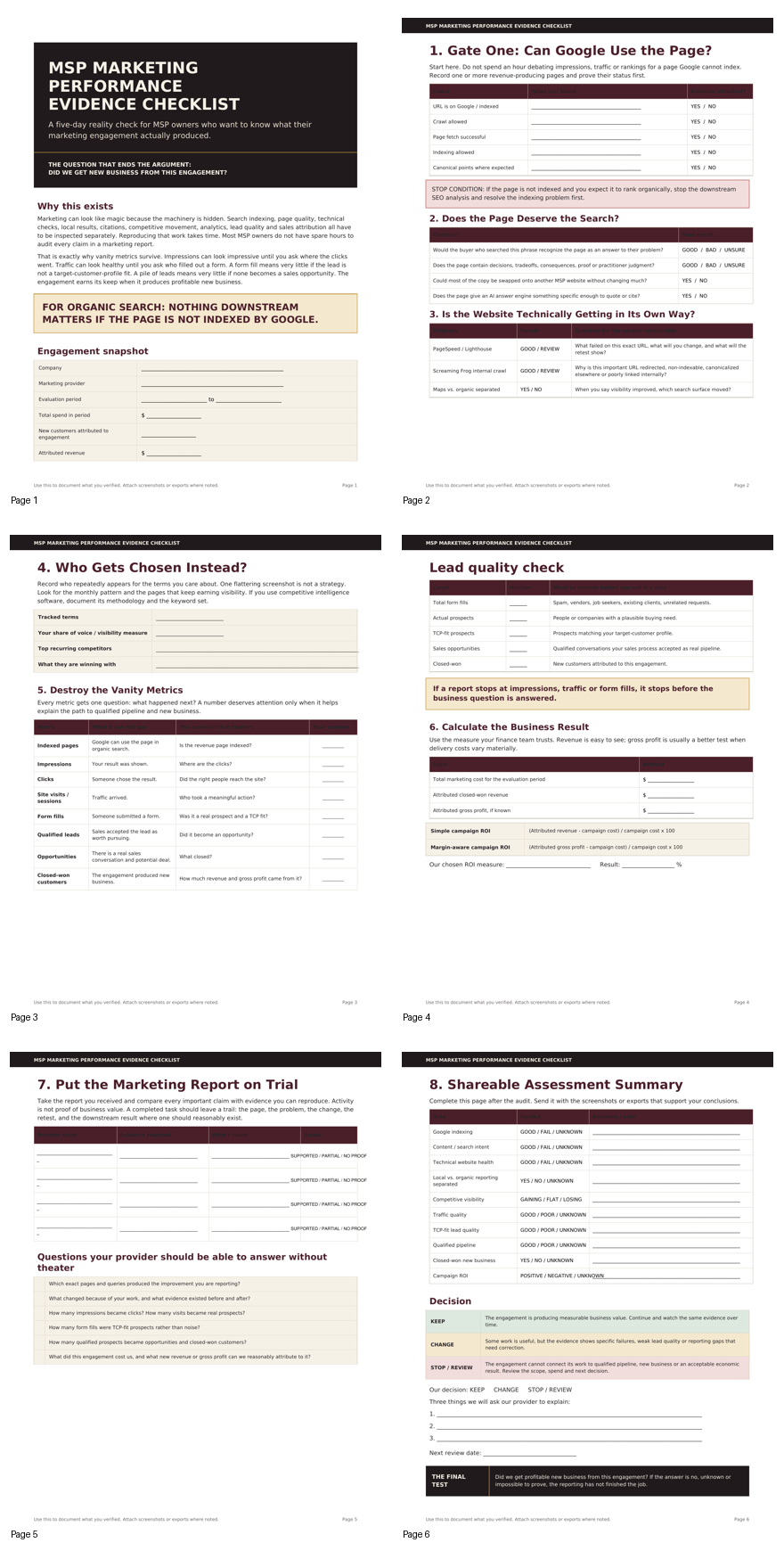
Download the MSP Marketing Performance Evidence Checklist — Free PDF
No form, email gate, or paywall.
Use it to record what you verified, what you could not verify, and which questions somebody still owes you an answer to.
Day 5: what to save before you stop
Save the completed checklist, the Search Console evidence, the analytics/CRM evidence, the campaign spend, and the exact provider claims you are testing. You will use those files in the repeatable AI audit below.
You are done for Day 5 when you can show how indexation connects to a business result, including the places where the evidence stops.
Build the MSP Website Audit Once, Then Let AI Repeat It
After you do this manually once, AI becomes useful for the part that is genuinely repetitive: reading the same types of evidence, comparing claims with records, and finding missing proof.
Do not ask an AI assistant to tell you whether your marketing is working from memory or vibes. Give it the evidence. Search Console exports. Screenshots. Analytics. CRM records. Invoices. The provider report. The checklist.
Use One MSP Marketing Evidence Vocabulary Every Time
| Status | Use it when... |
|---|---|
| Supported | The supplied evidence directly supports the claim |
| Partially Supported | Some of the claim is supported, but a material part is missing or narrower than stated |
| Unsupported | The supplied evidence does not support the claim |
| Contradicted | Supplied evidence conflicts with the claim |
| Cannot Determine | The evidence needed to make the call was not supplied |
That vocabulary matters because "looks good" is not an audit result. A claim is supported, partly supported, unsupported, contradicted, or impossible to determine from the files you have.
The classification language also stops AI from smoothing over missing evidence. Models are very good at producing a coherent story from incomplete material. That is useful when you are brainstorming and dangerous when you are auditing spend.
If the report claims "lead generation improved" and the only file supplied is a traffic chart, the correct answer is not a persuasive paragraph about how traffic can support future growth. The correct answer is Cannot Determine. We are missing the lead evidence.
That discipline is the whole point of the repeatable prompt below.
Why the AI audit comes after the manual audit
AI can compare documents much faster than a person can. It can read a provider report beside Search Console exports, a CRM export, a checklist, and an invoice, then point out where the claim and evidence do not line up.
What AI cannot do is recover evidence that was never captured. CRM qualification that was never recorded stays missing. An unrecorded competitor ranking cannot be reconstructed reliably after the fact. Confident language in a report does not create attribution evidence.
Do the audit manually once so you understand the evidence. Then use AI to repeat the comparison work without giving up judgment.
Reusable prompt: MSP Marketing Accountability Audit
Copy the full evidence-review prompt
Act as an independent MSP marketing-performance auditor.

Use only the evidence I provide. Do not invent rankings, traffic, leads, revenue, causes, competitors, or missing metrics. Do not treat an activity metric as a business outcome.

For every marketing promise or performance claim I provide:
1. Quote the promise or claim exactly.
2. State what evidence would be required to support it.
3. List the evidence I actually supplied.
4. Classify the claim as Supported, Partially Supported, Unsupported, Contradicted, or Cannot Determine.
5. Explain the classification in plain English.
6. Identify any spend tied to the work when that evidence is supplied.
7. Flag vanity or activity metrics that do not prove movement to the next business stage.
8. Identify factual conflicts between reports, screenshots, analytics, CRM records, invoices, and scope language.
9. Identify promised deliverables that cannot be verified from the supplied evidence.
10. Write the exact question I should send to the provider to resolve each gap.

Trace organic-search evidence in this order:
Indexed by Google -> relevant impressions -> clicks -> visits -> form fills/calls/bookings -> target-customer-profile fit -> opportunity -> closed-won customer -> attributable revenue or gross profit -> ROI.

For competitive analysis, use only the competitor and ranking evidence I supply, including Jackdaw data when provided. Do not invent competitor rankings or use unsupported memory.

Do not make a legal determination about breach of contract. If supplied contract or scope language appears inconsistent with the evidence, label it "Potential Contract Issue for Review" and quote both the promise and the conflicting evidence.

End with:
- What is supported as working
- What appears to be waste
- What I can reasonably do myself
- Where outside expertise is justified
- What I should stop, question, or renegotiate
- Five questions I should answer before spending another dollar

Finish with one direct answer: based on the supplied evidence, did this engagement produce new business, and what remains impossible to prove?
AI can organize evidence quickly. It cannot create evidence you never collected. That is why the five-day audit comes first.
The Free Tool Stack for This MSP SEO Audit
The tool list looks longer than the job because each tool answers one narrow question. You are not expected to become expert in all of them.
Search Console answers what Google reports about your own pages. PageSpeed and Lighthouse show technical behavior. A Screaming Frog crawl shows you the structure and status of your own site. Maps shows local visibility. GA4 and the CRM tell you what visitors and prospects did. Jackdaw is only for the competitive-intelligence part when doing that collection manually stops being a good use of time.
You can do the owner-level version of this audit without buying a giant SEO suite.
Open the free-tool stack and what to save from each tool
| Tool | Use it for | Evidence to keep |
|---|---|---|
| Google Search Console | URL Inspection, index status, page/query performance, sitemap evidence, own-site links | Screenshots/exports with URL and date |
| Google Search | Manual result checks and rough site: checks | Exact query, date, search conditions |
| PageSpeed Insights | Lab and available field-performance evidence | Dated report for the exact URL |
| Chrome Lighthouse / DevTools | Second technical view when a developer needs more detail | Failing audit or trace tied to the URL |
| Screaming Frog free version | Own-site crawl for status, indexability, redirects, canonicals, internal links | Crawl export filtered to the URLs that matter |
| Google Business Profile / Maps | Local presence | Query, location context, date, result |
| Google Analytics / GA4 | Landing-page traffic and configured conversions | Source/medium, landing page, conversion event |
| Google AI Overviews | Point-in-time citation evidence | Query, date, visible citation/source |
| Google Sheets | Dated audit log | One row per observation |
| CRM | TCP fit, opportunities, closed-won, revenue | Lead/contact/account/opportunity record |
| Jackdaw | Targeted competitive intelligence | Report for the competitors and searches the MSP actually cares about |
The free method stays in this article on purpose. You should be able to understand the work before anyone sells you a shortcut.
Frequently Asked Questions About MSP Website Rankings
These answers are written so each one can stand on its own. That helps the person skimming the page, and it gives search and AI systems a complete answer they can extract without needing three paragraphs of surrounding context.
Why the FAQ answers repeat part of the question
An answer such as "Because Maps and organic are separate" makes sense when you are looking at the question directly above it. It becomes vague when the answer is quoted on its own.
"Your MSP can show in Google Maps while the website performs poorly in organic search because Maps and organic results are separate search surfaces" carries the subject into the answer. A human can understand it immediately, and an answer engine can lift it without losing the meaning.
That is deliberate, not keyword stuffing.
Why isn't my MSP website ranking on Google?
Your MSP website usually fails to rank because the page is not indexed, does not match the buyer's search well enough, has a technical problem, lacks enough authority for that competitive result, or is simply being beaten by stronger pages. Start with the exact URL in Google Search Console. If Google has indexed it, move to search intent, technical evidence, and the pages already winning the query. Diagnose the failed stage before you buy a fix.
How do I know if Google has indexed my MSP website?
You know Google has indexed your MSP website when URL Inspection in Google Search Console reports that the exact page is indexed and shows the canonical Google selected. Check the page URL you expect to rank, not just the homepage. A site: search is a rough public spot check; Search Console is the better source for a site you control.
How long does it take a new MSP website page to rank on Google?
A new MSP website page has no fixed ranking deadline. Discovery and indexation can happen before the page earns useful visibility, and ranking movement depends on the query, competing pages, relevance, internal support, and authority around the topic. Record the publication or change date, confirm when Google crawls and indexes the page, then judge repeated search evidence rather than tomorrow morning's screenshot.
What's the difference between crawling and indexing an MSP website?
Google crawling means discovering and fetching the URL. Google indexing means retaining the processed page in the searchable index. A page can be crawled and still remain unindexed. The ranking stage comes after indexation, when the page competes for a specific query.
Why does my MSP show in Google Maps but not organic search?
Your MSP can show prominently in Google Maps while the website performs poorly in organic search because Maps/local results and organic website results are separate search surfaces. Track them separately. A first-place Maps screenshot proves local visibility for that query, location context, and moment; it does not prove that your service page holds the first organic position.
Does navigation affect MSP SEO?
Navigation affects MSP SEO because internal links give search engines discovery paths and help show how important pages relate to the rest of the site. A revenue page buried several clicks deep or barely linked from relevant pages deserves inspection. Check whether the intended page appears in the site's normal navigation structure, sitemap, and relevant internal links before blaming Google for not finding it quickly.
Can an MSP website page rank without backlinks?
A page can rank without backlinks, especially where competition is modest and the page strongly answers the search. Backlinks become more important when competing pages have stronger outside evidence and authority. Check indexation, intent, page quality, technical condition, and internal support before deciding link acquisition is the missing piece.
Why does a competitor with a worse website rank above my MSP?
A competitor with a worse-looking website can rank above your MSP because Google is evaluating the usefulness and signals around the ranking page, not awarding points for design taste. Compare the exact page that outranks you: what it answers, how specifically it answers it, how the rest of the site supports it, and what outside sources reference it. The ugly site can still have the better answer.
Where Jackdaw Fits in MSP Marketing
You can do everything in this audit manually. I wanted the process public because you should not have to buy software to understand whether somebody's marketing explanation makes sense.
I also do not do all of this manually for Fox & Crow every month.
We built Magpie for our own use because rebuilding competitive intelligence by hand is labor I would rather spend making decisions. Magpie uses the same underlying technology as Jackdaw, but it tracks the markets and competitors relevant to Fox & Crow.
Instinct is our broad MSP intelligence system. It gives us market-wide visibility across the full MSP database we maintain, about 110,000 businesses.
Jackdaw is the MSP-facing version. It focuses competitive intelligence on the MSPs and markets that customer cares about and packages the information as a report the owner can act on.
Jackdaw does not fix your SEO. It does not write content, manage listings, build links, or run your marketing. It saves the labor involved in repeatedly collecting and organizing the competitive evidence.
I just spent five days showing you how to get this information yourself because I do not believe you should have to buy software to understand whether your marketing is working.
Do it yourself for free if you have the time. I mean that. Once you understand the work, you can decide whether doing it every month is a good use of yours.
Do the five days yourself once. Learn what the evidence looks like. Learn which questions matter. Then decide which work is worth keeping in-house and which labor you would rather buy back.
If you don't own the learning, you don't own the result.
And if somebody wants to impress you with a marketing metric, keep asking questions until you get to the one that pays the bills:
Did we get new business from it?