REPORT EXPLAINED

How to Read Your Jackdaw MSP Report

The report exceeds thirty pages of competitive intelligence covering your business and the rivals competing for the same customers in your market. It identifies where your business is winning, where it is losing ground, and which competitor is capturing that ground.

This page addresses each section in sequence: what the section measures, why the measurement affects your pipeline, and what action the finding requires. You do not need a marketing background to use this page, and you do not need to hire anyone to act on it. Every recommendation is written for execution by you and your existing team.

Where a finding requires more explanation than a paragraph can provide, this guide links to a complete walkthrough in the free MSP marketing guide. The guide is free, requires no email address, and carries no retainer. The report establishes your position. The guide provides the method for improving it.

BEFORE YOU START

Three conventions apply throughout the report. Understanding them here makes every subsequent section easier to interpret.

Most measures are scored on a scale of 0 to 1, where a higher score is better. These are not grades. They are maturity scores, measuring your position relative to the strongest performer in your local market rather than against an abstract standard. A score of 0.80 indicates a position near the top of your local market on that measure.

Every comparison provides three figures: your score, the field median, and the leader. The median represents the midpoint of your local competitive field; exceeding it is a minimum requirement, not an achievement. Falling below it indicates that customers are choosing a competitor instead of you. The leader is named in every case, identifying the specific standard your business must meet to lead the field.

Every identified problem also carries a severity tag of HIGH, MEDIUM, or LOW. This tag reflects the cost of the problem in customers and revenue, not the difficulty of fixing it. Some HIGH-severity items require only a few hours of work. Prioritize the list by cost, not by ease of implementation.

SECTION 01

Executive Summary

What this section is
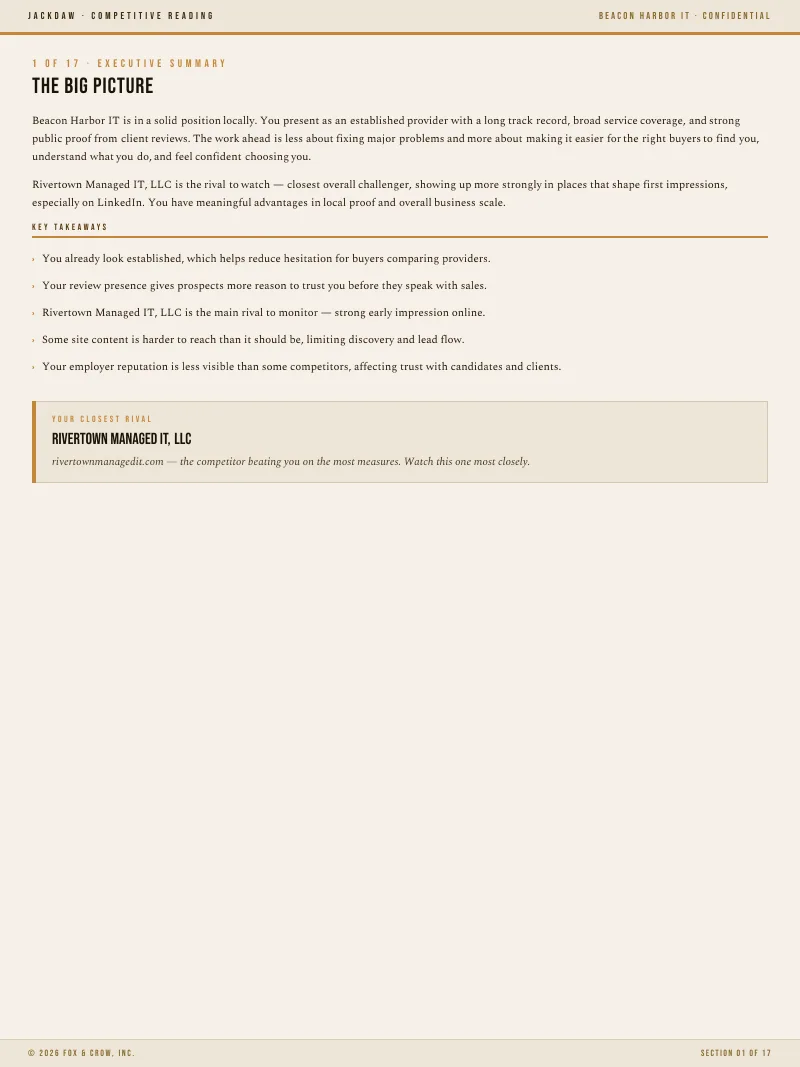
A single page summarizing the entire report: your overall competitive position, the one rival that warrants the closest attention, and five findings worth retaining. This page represents the market's first impression of your business, the version encountered by a prospective client before your service quality, your technicians, or your track record become relevant.
Why it matters

This page serves two distinct purposes. First, most competitive intelligence reports go unread beyond the opening pages, since few owners can allocate a full afternoon to a lengthy document. This page ensures that even a single reading produces a clear answer to the two questions that matter most: where the business stands, and what represents the greatest risk.

Second, and more consequential, prospective clients conduct this same research independently, before any conversation with your business takes place. This occurs at four identifiable points: after receiving a referral, after a cold outreach from your sales team, when dissatisfaction with a current provider prompts a search for alternatives, and before completing a contact form or scheduling a call. A referral secures initial consideration. It does not complete the sale. The prospect's independent research, conducted against your website, your reviews, your Google presence, and the story your business tells about itself, must hold up without a person present to explain or defend it.

According to Fox & Crow Instinct, our MSP Decision Intelligence Platform, this independent research typically favors visibility over service quality as the deciding factor. In a full-market audit of 37,394 MSPs, 92 percent had zero measurable search visibility, only 16 percent ranked for any keyword, and just 5.6 percent generated sufficient traffic for Google's own field data to register. The businesses exist. Prospective clients do not find them.

The conclusion follows directly: superior service does not guarantee that a business wins the engagement. The provider found first, perceived as credible fastest, and least likely to raise doubt typically receives the first conversation, regardless of comparative service quality.

How to read yours

Read this page twice: once before proceeding to the remainder of the report, and once again after completing it. The first reading identifies which sections warrant the closest attention. The second reading differs meaningfully, since every line will by then connect to evidence already reviewed.

On the first reading, evaluate three distinct elements: what a prospective buyer can already trust about your business, what characteristics might cause a weaker competitor to appear safer or more established than your business, and which specific rival is best positioned to exploit that gap. This rival is not necessarily the strongest MSP in your market. It is the competitor your public presence is least equipped to address.

What to do with it

This page produces no task to complete at this stage. It exists to establish orientation, not to prescribe action; the specific remediation for each finding is addressed in the sections that follow. Resist the temptation to act on the summary alone. Its function is to establish the stakes: if the summary indicates that your evidence is thin, your services are unclear, or a competitor presents a more complete picture, treat each of these as a risk to revenue, not a stylistic concern.

Free Guide to MSP Marketing Strategy: the strategy behind everything this report covers. If you read only one guide, read this one.
Jackdaw report page: Executive Summary
SECTION 01
From a real Jackdaw MSP report. Click to enlarge.

SECTION 02

How to Read This Report

What this section is
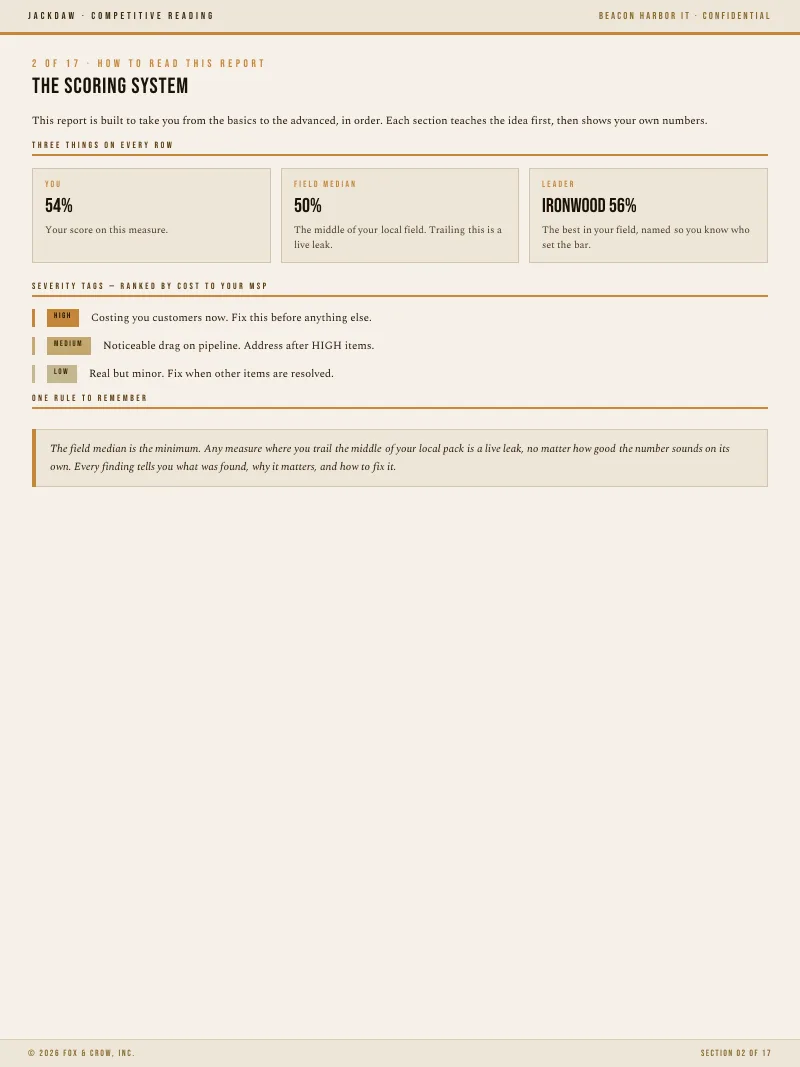
A single page explaining the scoring system used throughout the report: maturity scores, field medians, named leaders, and cost-based severity tags. Its purpose is to prevent a common misreading, treating these figures as academic grades rather than competitive position.
Why it matters

This context matters for two distinct reasons. First, a figure such as "website maturity: 54 percent" invites misinterpretation without it. The figure does not indicate that the website is barely passing an absolute standard. It indicates a specific competitive position within a specific market, which the report identifies precisely.

Second, and more fundamentally, prospective buyers do not evaluate a business against an abstract standard. They compare it to the other providers they are able to locate, and by the time a buyer initiates contact, an impression regarding credibility, currency, and safety has typically already formed. A score functions as a proxy for that impression: it indicates whether a business appears stronger or weaker than whichever competitor the buyer is evaluating it against.

Data from Fox & Crow Instinct confirms that the common explanations for invisibility do not hold. Visible and invisible MSPs carry nearly identical domain ages, 16.8 years for visible providers versus 17.1 years for invisible ones. A business with a domain over twenty years old remains approximately 89 percent likely to have zero search visibility. Company size provides no protection either: small and midsize providers reach a healthy search-results position at roughly twice the rate of large providers. Visibility is not conferred by age, size, or established reputation. It results from specific, identifiable actions.
How to read yours
Review this page once at the outset, then return to it whenever a figure elsewhere in the report requires context. The same three-figure pattern recurs throughout the report: your score, the field median, and the leader. Interpret them in that sequence. Your score establishes your current position. The field median establishes the minimum standard a buyer is likely to observe in your market. The leader identifies who has already set the visible benchmark. A score below the median indicates a competitive vulnerability. A score far below a specific rival indicates that rival holds a material advantage. A score at or above the leader indicates a strength worth protecting and reinforcing.
What to do with it
Apply one governing rule: the median represents a minimum standard, not an average to be satisfied. Any measure where your business trails the local field median constitutes a competitive vulnerability, regardless of how reasonable the raw figure appears in isolation. Apply the severity tags accordingly, without regard for personal preference: a HIGH tag does not indicate difficulty, and a LOW tag does not indicate irrelevance. Each tag reflects the measure's cost in customers and revenue. Sequence your effort according to buyer impact, not according to which fix is most comfortable to address first.
Jackdaw report page: How to Read This Report
SECTION 02
From a real Jackdaw MSP report. Click to enlarge.

SECTION 03

Getting Found, Then Getting Trusted

What this section is
This is the organizing framework for the entire report. Marketing performs one function: converting a prospective client who needs IT support into a client who contacts the business. That conversion occurs in a fixed sequence, and the sequence cannot be reversed. The prospect must first find the business. Only then does the question of trust become relevant.
Why it matters
Marketing failures fall into exactly two categories, and the appropriate remedy depends entirely on which category applies. A visibility failure means qualified prospects do not locate the business; no investment in credibility resolves this failure, since credibility becomes relevant only after a prospect has already found the business. A trust failure means prospects locate the business but are not persuaded to make contact; no investment in visibility resolves this failure, since additional traffic to an unconvincing website merely produces a larger number of prospects who decline to call. Nearly every marketing expenditure that fails to produce results can be traced to a misdiagnosis between these two categories.
How to read yours
As you review the remainder of the report, classify each finding into one of these two categories. Local search rankings (Section 08), technical SEO (Section 09), and structured data for AI search (Section 14) belong to the visibility category. Email and website security (Section 06), competitive battle cards (Section 07), reviews (Section 10), marketing activity (Section 11), hiring and team signals (Section 12), and website messaging (Section 13) belong to the trust category. Every remaining section of the report (the health score, the competitive scoreboard, and the project plan) measures or sequences findings from these two categories rather than adding a third.
What to do with it

Determine which category represents the greater weakness for your business specifically, using the evidence presented in the sections that follow rather than intuition. Owners commonly assume trust is the primary weakness when the data indicates otherwise. The remainder of this report is structured to test that assumption directly.

Free Guide to MSP Marketing Strategy: the complete version, including a five-minute self-diagnostic and links to every guide referenced below. Every other guide in this series extends from it.
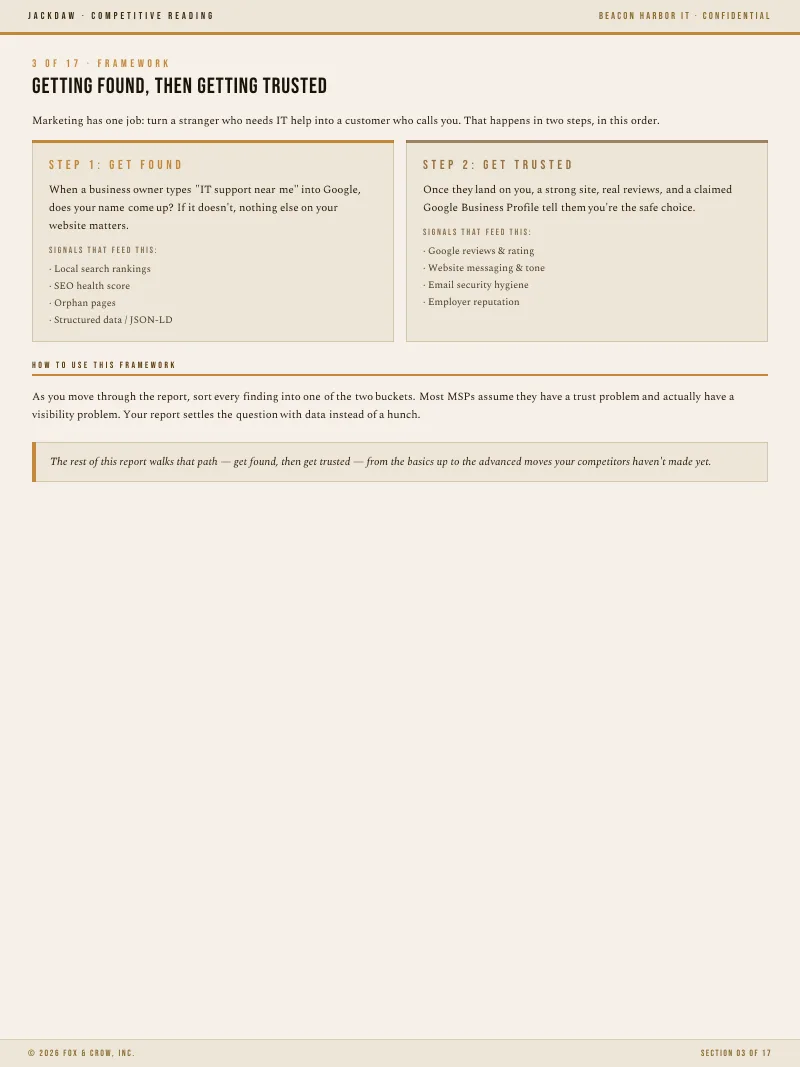
Jackdaw report page: Getting Found, Then Getting Trusted
SECTION 03
From a real Jackdaw MSP report. Click to enlarge.

SECTION 04

Your Health Score and Where to Focus

What this section is
A single composite score, out of 100, constructed from twelve signals that prospective buyers notice, accompanied by the two or three specific factors currently exerting the greatest negative effect on that score.
Why it matters
This score performs two distinct functions. It establishes a baseline against which future improvement can be measured, since progress cannot be assessed without a fixed starting point. It also converts twelve disparate signals into a single figure simple enough to be retained and tracked without a spreadsheet or specialized software.
How to read yours
The score itself is less informative than the two figures presented alongside it. "Points within reach" indicates the potential increase in score if every identified fix were implemented. The focus areas listed below identify the two or three problems currently causing the greatest damage to the score. These are selected by impact, not by ease of implementation.
What to do with it

Record the score together with today's date, then address the focus areas as you proceed through the remainder of the report. When the assessment is repeated at a later date, this recorded score becomes the benchmark that demonstrates whether the work produced a measurable return.

Free Guide to Your MSP Marketing Health Score: how the score is built, and a repeatable scorecard for tracking it yourself between reports.
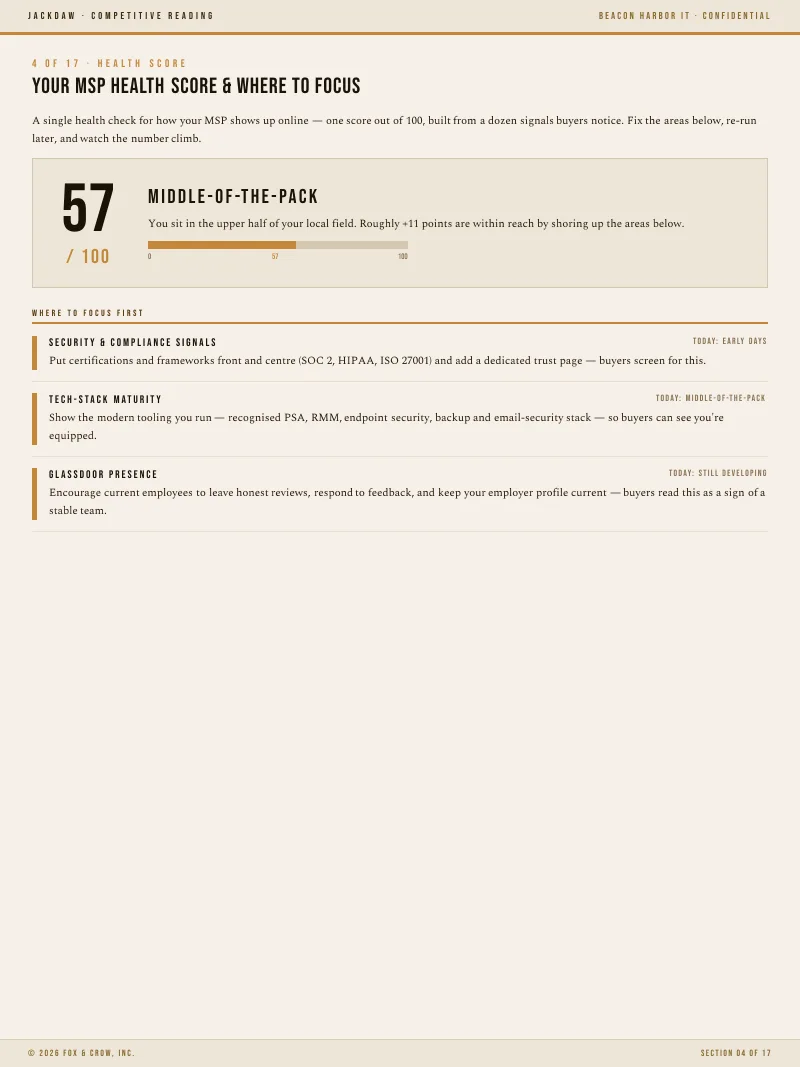
Jackdaw report page: Your Health Score and Where to Focus
SECTION 04
From a real Jackdaw MSP report. Click to enlarge.

SECTION 05

Where You Stand Against Local Competitors

What this section is
The complete competitive comparison: every identified rival in your market, scored using an identical methodology across web presence, activity, SEO, reputation, growth signals, and service offering. The section opens with a summary of strengths, weaknesses, opportunities, and threats, followed by the complete comparison matrix showing your rank on every measure.
Why it matters
Prospective clients already conduct this comparison independently, typically in ten minutes using an unstructured Google search. This section performs the same comparison using a consistent methodology, in advance of a prospect conducting it informally and drawing an unqualified conclusion.
How to read yours
Review the matrix for two distinct patterns. First, any measure where your business trails the field median represents a competitive vulnerability. Second, any measure where a single rival has advanced substantially beyond the remainder of the field identifies a specific point where customers are choosing that competitor instead of you, and the report names that competitor directly. Where your business leads a given measure, record it; these strengths become supporting evidence for the battle cards addressed later in the report.
What to do with it

Identify the two weakest measures that are actually visible to prospective customers, not the two that would be easiest to address. The remainder of the report provides a specific remedy for each, and the project plan at the conclusion of the report sequences the work.

Free Guide to Reading the MSP Competitive Landscape: a repeatable scoring rubric for tracking your position against local competitors on your own.
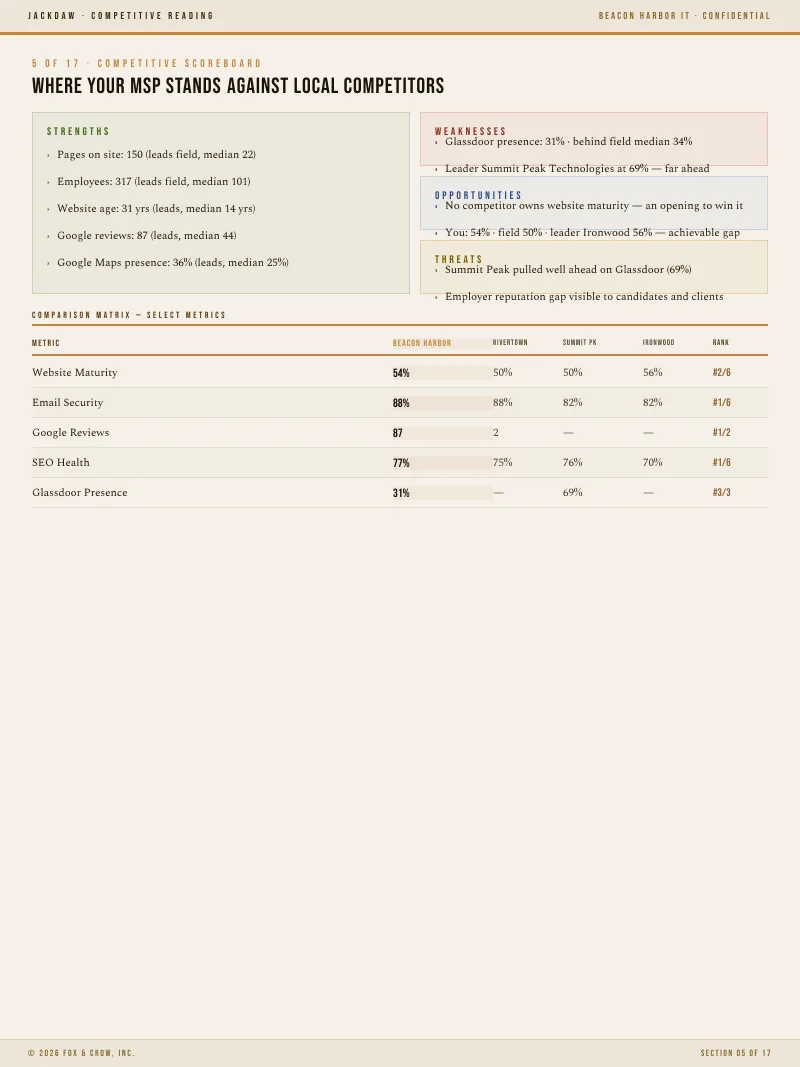
Jackdaw report page: Where You Stand Against Local Competitors
SECTION 05
From a real Jackdaw MSP report. Click to enlarge.

SECTION 06

Your Email and Website Security

What this section is
An assessment of your business's own security hygiene, as visible to the public: SPF, DMARC, and DKIM email authentication, your HTTPS certificate, and the reliability of your website's uptime. In plain terms, SPF and DKIM let a receiving mail server confirm that an email claiming to come from your domain actually did; DMARC tells that server what to do with a message that fails the check: reject it, quarantine it, or let it through. Together, the three make it materially harder for someone to send a convincing phishing email that appears to come from your business.
Why it matters
This assessment matters for two reasons specific to the MSP business model. First, a business that sells security services undermines its own claim by exhibiting visible security gaps of its own; a prospective client evaluating security competence applies that evaluation to the vendor as well as to the vendor's proposed solution. Second, these particular gaps are not difficult to discover: any prospect with access to a free public lookup tool can identify a missing DMARC record in under a minute, which means the inconsistency is available to precisely the buyers most likely to notice it.
How to read yours
A green indicator confirms that the corresponding basic requirement is satisfied. Any flagged item includes a specific, actionable instruction for remediation.
What to do with it

Assign any flagged items to whoever on your own team handles email and DNS. It's the same category of work your business performs for clients daily. In practice, remediation means publishing or correcting a small number of DNS text records with your domain registrar or DNS host: one listing which mail servers are authorized to send on your behalf, one enabling cryptographic signing of outgoing mail, and one instructing other mail servers on how to handle messages that fail those checks. This typically requires less than one hour and closes a credibility gap before a prospective client identifies it independently. Your competitors received an identical assessment, and any gaps in their results appear directly in the comparison matrix.

Free Guide to MSP Email & Website Security: the one-hour checklist, with every fix specified step by step and the free tools required to verify each one, written for an internal fix rather than an outside vendor.
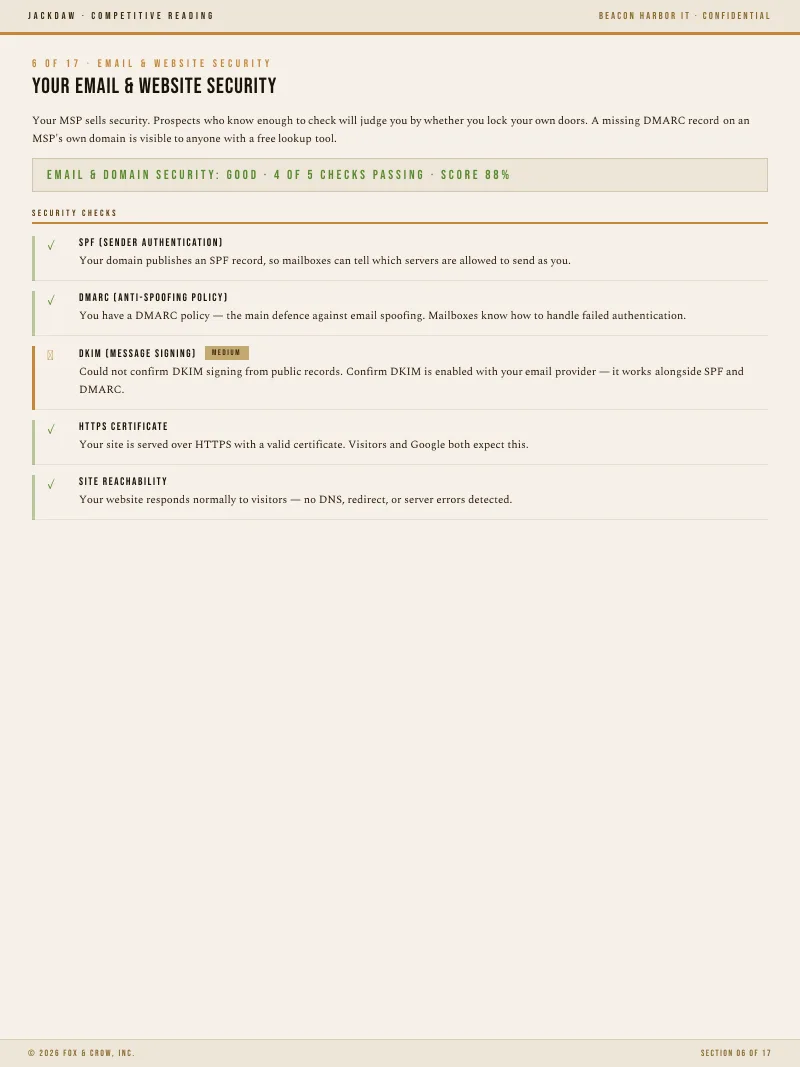
Jackdaw report page: Your Email and Website Security
SECTION 06
From a real Jackdaw MSP report. Click to enlarge.

SECTION 07

Head-to-Head Battle Cards

What this section is
One card per competitor, constructed for the way sales engagements actually occur: a prospect evaluating your business against one specific alternative. Each card identifies where your business wins, where the competitor wins, a recommended response for when the prospect raises that competitor's name, and suggested website copy that positions your business against them. The section opens with a service analysis identifying which offerings are advertised locally by your business alone.
Why it matters
When a prospect states that a competing provider is also under consideration, the response determines the outcome disproportionately. A specific, factually grounded answer advances the sale. A vague, defensive, or dismissive answer typically ends it.
How to read yours
Begin with the service analysis. Offerings advertised by your business alone represent genuine differentiators, and the specific offerings identified frequently surprise business owners reviewing their own results. Proceed to the card for whichever competitor is raised most frequently in active sales conversations.
What to do with it

Distribute the recommended responses to everyone who interacts with prospects, including yourself, and rehearse each one aloud, since they are written for spoken delivery. Each response acknowledges the competitor's genuine advantage honestly; retain this approach in any further development of the material. Denying that a competitor holds any advantage damages credibility with any prospect who has already conducted independent research. The suggested copy can be adopted for your website with minimal modification.

Free Guide to MSP Sales Battle Cards: the same four-box format, for the competitors not covered in your Jackdaw Report.
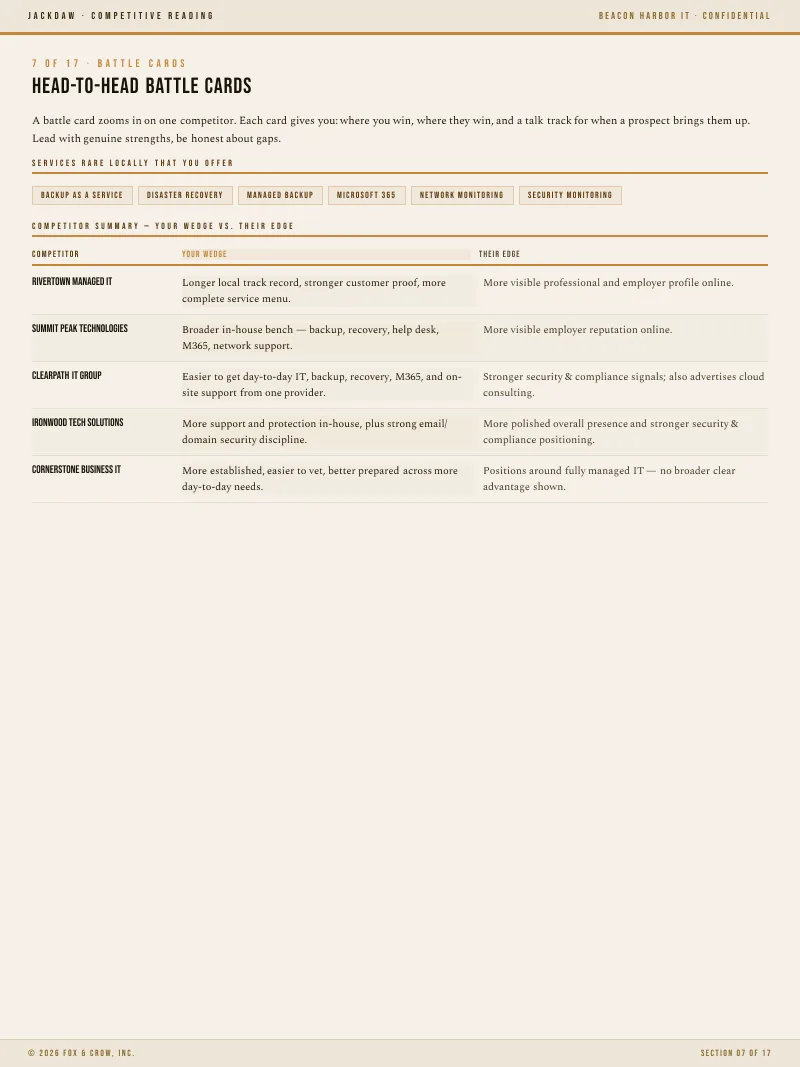
Jackdaw report page: Head-to-Head Battle Cards
SECTION 07
From a real Jackdaw MSP report. Click to enlarge.

SECTION 09

How Customers Find You on Google

What this section is
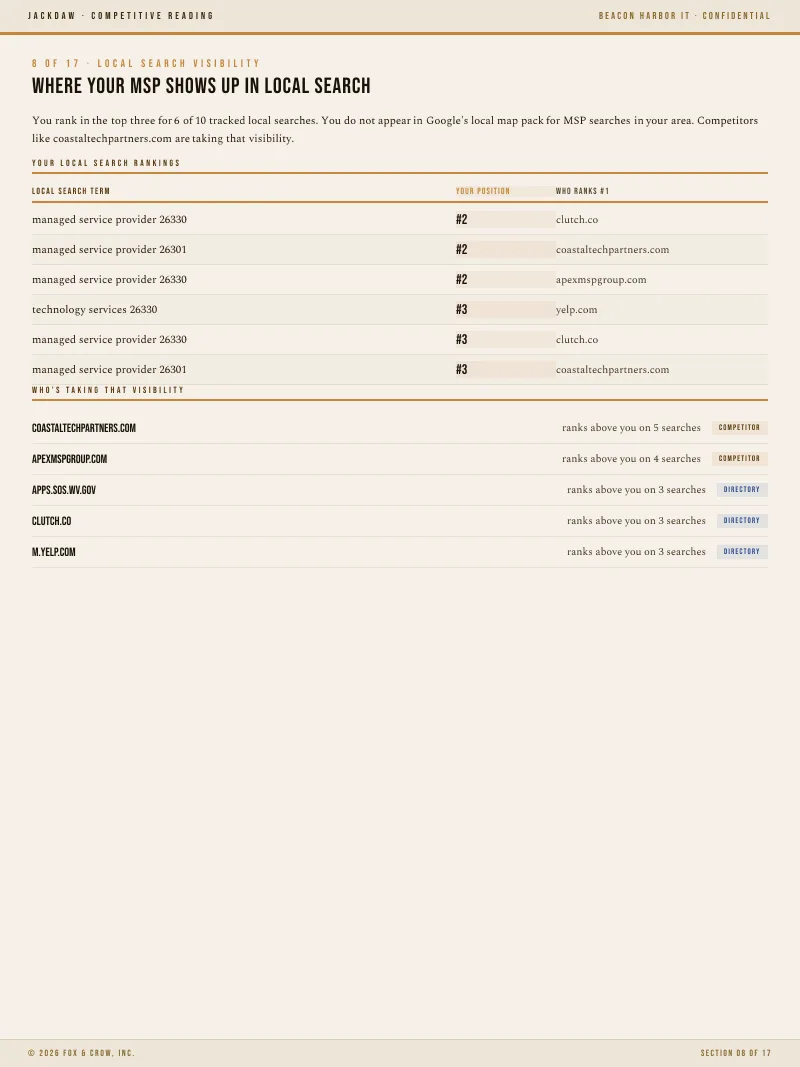
An assessment of your website's relationship with Google: whether Google can read the site, whether all pages are reachable, how quickly the site loads, which searches the business already ranks for and which are within reach, together with a prioritized list of technical fixes and corresponding instructions.
Why it matters
Technical SEO is neither a manipulation technique nor a service requiring an ongoing retainer. It consists of a defined set of signals that a website either transmits clearly or transmits ambiguously, and the majority of associated problems require a one-time correction rather than continuous maintenance. A website that Google cannot fully read remains invisible regardless of the quality of its written content. In practice, the most common causes are a robots.txt file that unintentionally blocks Google, broken internal links, pages that display correctly to a visitor but fail to load for Google's automated crawler, and pages slow enough that Google deprioritizes them.
How to read yours
Begin with the severity tags and review the HIGH items first. Each fix specifies what was identified, its cost to the business, and the required remediation, written to be handed directly to whoever built the website without further explanation. The "within reach" list identifies the fastest available gains: searches in which the business ranks just outside the top three, where a small improvement produces a position on the first page.
What to do with it

Turn the HIGH and MEDIUM fixes into a work order for whoever maintains the website, whether that is someone on your own team or an outside contractor; the instructions are written to be used directly by either. Most items also identify the specific free tool required to validate the fix, in case you choose to implement them yourself. Do not disregard an orphan pages finding if one is present: a page with no internal links pointing to it receives minimal credit from Google regardless of its content.

Free Guide to MSP SEO: the complete DIY checklist, covering every fix in this section in full, with free tools named throughout.
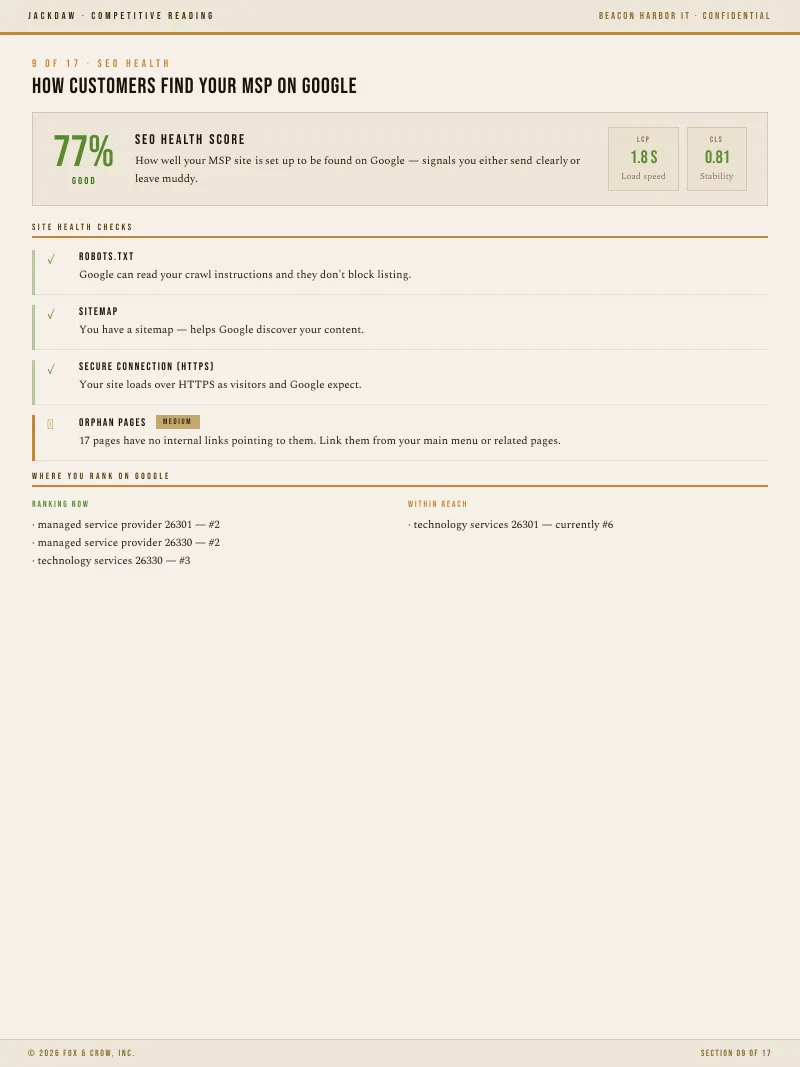
Jackdaw report page: How Customers Find You on Google
SECTION 09
From a real Jackdaw MSP report. Click to enlarge.

SECTION 10

Reviews and Local Presence

What this section is
The status of your Google Business Profile, your review count and rating measured against your local field and the national median, your rating trend over the preceding year, and your Glassdoor presence as described by current and former employees.
Why it matters
When a business owner requires IT support urgently, the typical behavior is to search, review the map results, and contact one of the two or three listings with the most recent and highest ratings, frequently without visiting a website at all. This makes reviews the lowest-cost, highest-return factor addressed in this report: it requires no advertising budget and no website redesign, only a claimed profile and a consistent request process.
How to read yours
Compare your review count to the field median, then examine the trend line. A high review count combined with a declining rating constitutes a warning sign, since prospective clients weight recent reviews heavily and any decline is visible to anyone who sorts results by date. Review the Glassdoor summary regardless of its content; both prospective clients and job candidates read it, and the language quoted there reflects how your market actually describes your business.
What to do with it

Establish one operating practice: every completed project or resolved support ticket that concludes with a satisfied client should conclude with a review request. Consistency outperforms volume; five reviews per month sustained over a year produces a stronger result than sixty reviews obtained in a single week. If the rating is declining, respond to critical reviews professionally and address the underlying operational cause. If the Glassdoor presence is thin or unfavorable, request honest reviews from current employees and respond to existing content.

Free Guide to MSP Reviews: a system for five a month, sustained indefinitely, with templates for the request and for handling the reviews you would rather not receive.
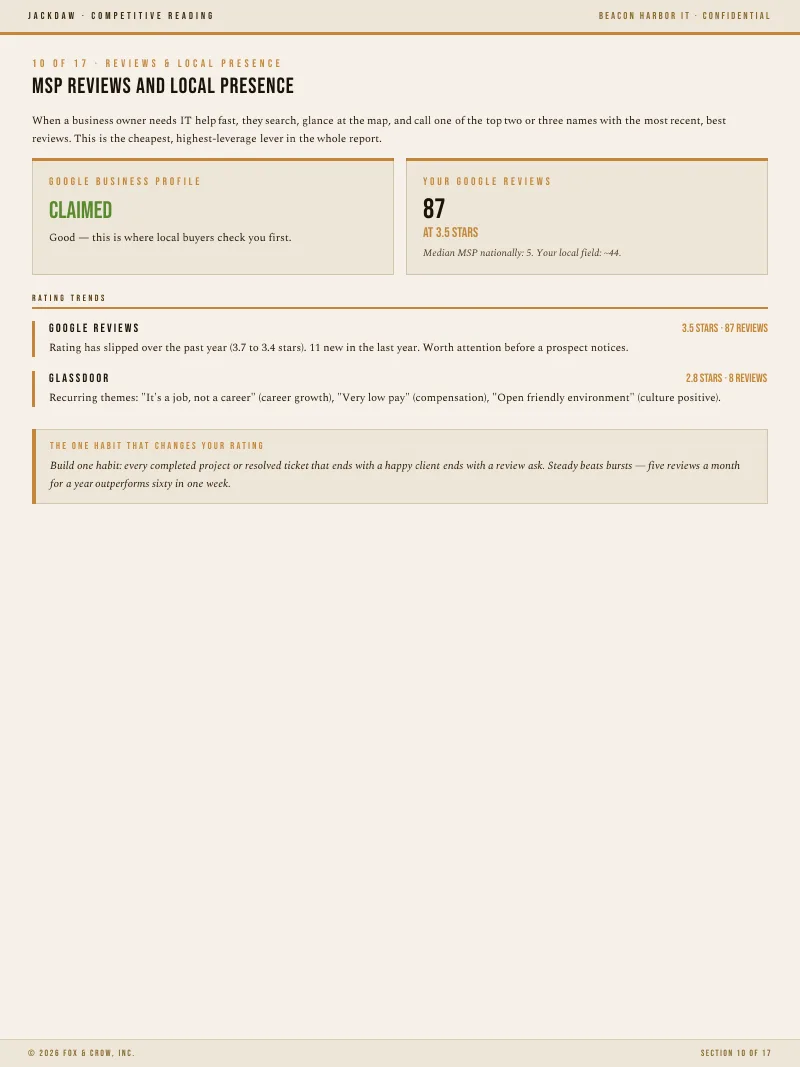
Jackdaw report page: Reviews and Local Presence
SECTION 10
From a real Jackdaw MSP report. Click to enlarge.

SECTION 11

Marketing Activity

What this section is
The posting frequency, audience size, and engagement level across the channels prospective clients review, together with an analysis of the actual subject matter of those posts and whether the content resonates with business buyers.
Why it matters
Prospective clients evaluate a business before making contact, using the same process the business itself would apply to a prospective vendor. An active, current presence signals organizational health. A feed with no activity in the preceding eight months introduces doubt that the business never becomes aware of, since the affected prospects simply do not call.
How to read yours
The numerical counts are less informative than the content analysis. Review the report's description of the feed's actual subject matter, then apply its central test: does the content read as an expert addressing a buyer's problem, or as a company describing itself? The report's conclusion regarding whether the content resonates with buyers is the single most important finding in this section.
What to do with it

Shift the content mix toward instruction and evidence: practical guidance in plain language, and brief accounts of specific outcomes achieved for clients. A single documented outcome outperforms ten generic service announcements. Maintain whatever posting frequency can be sustained indefinitely. Consistency signals organizational stability, and a modest, sustainable schedule outperforms an ambitious one abandoned within weeks.

Free Guide to MSP Social Media Marketing: what to actually post, with a content system and a schedule built for a team without a marketer.
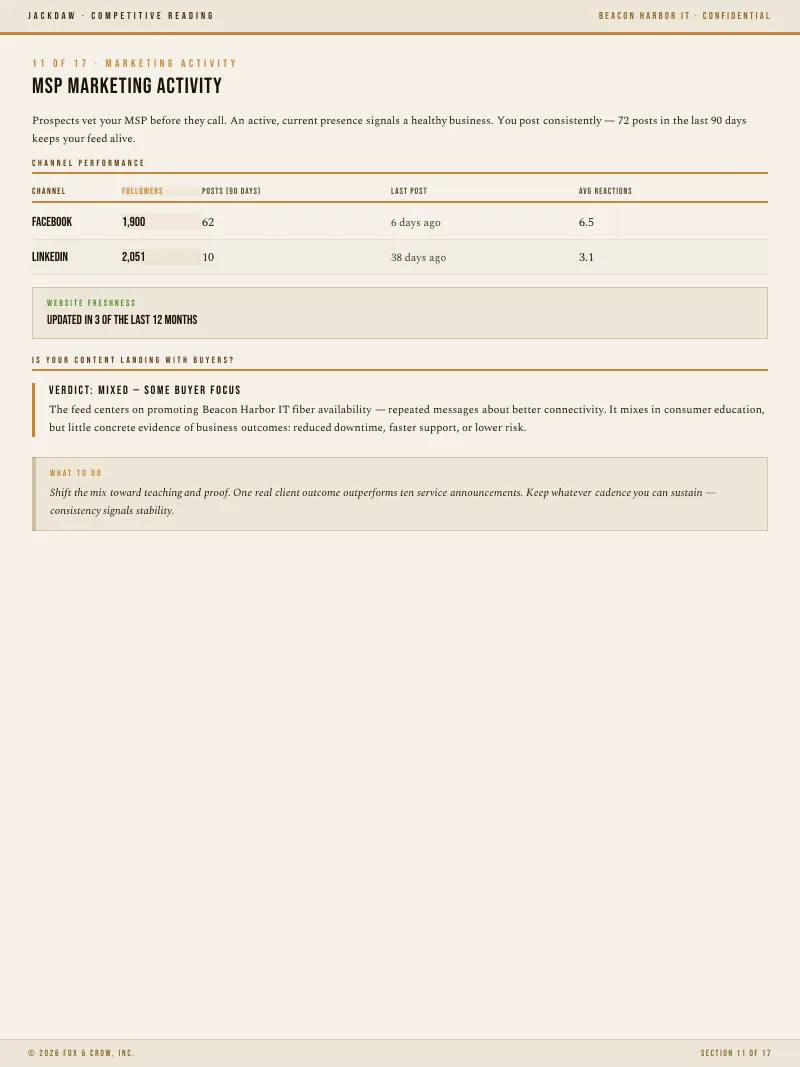
Jackdaw report page: Marketing Activity
SECTION 11
From a real Jackdaw MSP report. Click to enlarge.

SECTION 12

Hiring and Team Signals

What this section is
What public hiring activity indicates about your business and your competitors: active job postings, roles posted repeatedly, and the interpretation of these patterns when read alongside employee reviews.
Why it matters
Hiring activity is one of the few indicators of organizational health visible to an external party. Consistent hiring for new roles indicates growth. The same position posted four times within a year, combined with unfavorable employee reviews, indicates turnover. Turnover is experienced by clients directly, as inconsistent staffing and declining service quality.
How to read yours
Review your own repeated postings first, and assess honestly which pattern they indicate. Then review your competitors' patterns, since this section applies equally in both directions.
What to do with it

If a specific position continues to reopen, treat the finding as an operational issue rather than a marketing issue; addressing retention produces the marketing benefit indirectly. If a competitor exhibits the turnover pattern, this constitutes a legitimate, factual point in a sales conversation. Deploy it carefully: the phrasing "you may want to ask any provider how long their technicians have been with the company" raises the question without disparaging the competitor directly.

Free Guide to MSP Hiring & Retention: on reading your own hiring page the way a prospect does, and what to address first.
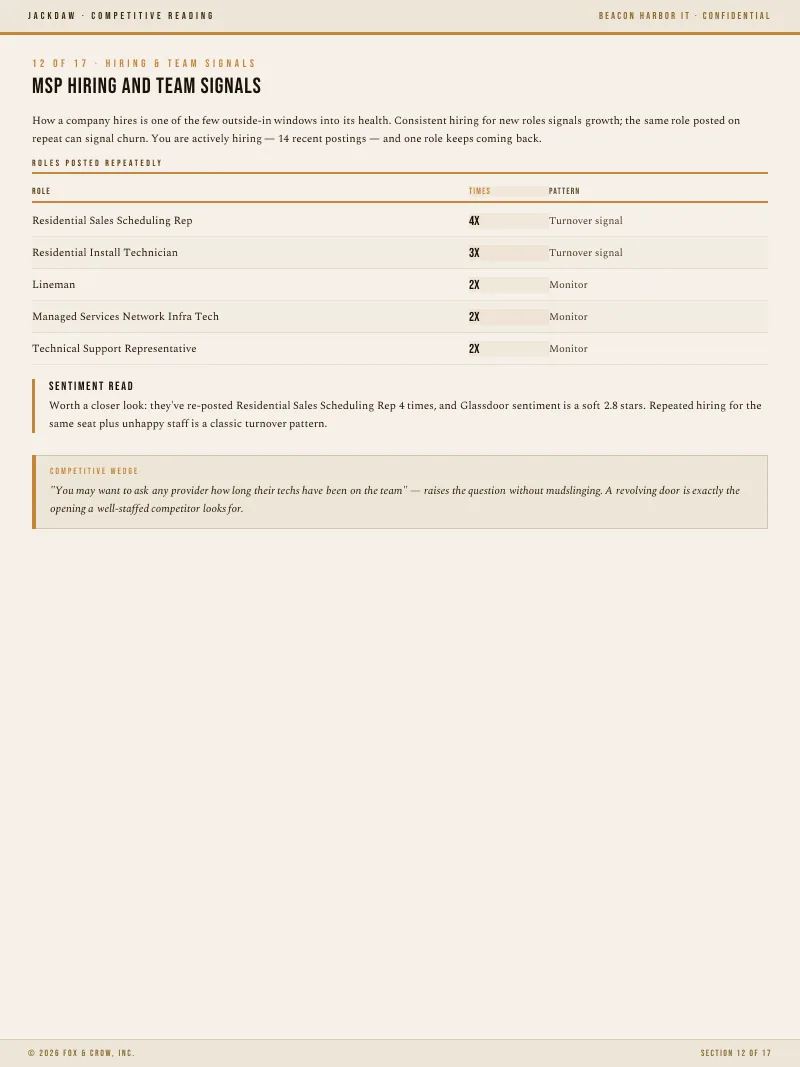
Jackdaw report page: Hiring and Team Signals
SECTION 12
From a real Jackdaw MSP report. Click to enlarge.

SECTION 13

Your Messaging and Tone

What this section is
An evaluation of the specific language on your website, tested against a single standard: address the buyer's problem rather than the provider's technical capabilities. Each finding quotes the existing copy, explains its cost to the business, and provides a revised version.
Why it matters
Once a prospective buyer has found a business, the specific language on the website is often the deciding factor in whether contact is made, alongside the other trust signals covered elsewhere in this report, reviews, security signals, and reputation among them. Most websites lose the engagement at this stage regardless of those other signals. A typical site states "24/7 SOC-backed EDR with ITIL-aligned processes" to a buyer whose actual concern is "my email keeps failing and I cannot afford to lose a day of operation." The website that wins the engagement states the second concern first.
How to read yours
Review the audience focus verdict first, since it establishes whether the existing copy addresses your actual buyer or an undifferentiated general audience. Then review each finding individually. Each finding presents a before-and-after comparison: the current sentence, followed by the buyer-focused revision.
What to do with it

Rewrite the homepage headline first, applying the pattern demonstrated in the report: state the outcome the buyer wants, in the buyer's own language, followed by the method of delivery. Address the remaining findings in order of severity. A copywriter is not required; the provided revisions can be used as written, and the underlying pattern can be learned within a single working session.

Free Guide to MSP Website Copywriting: the full rewrite pattern, with worked examples you can copy directly.
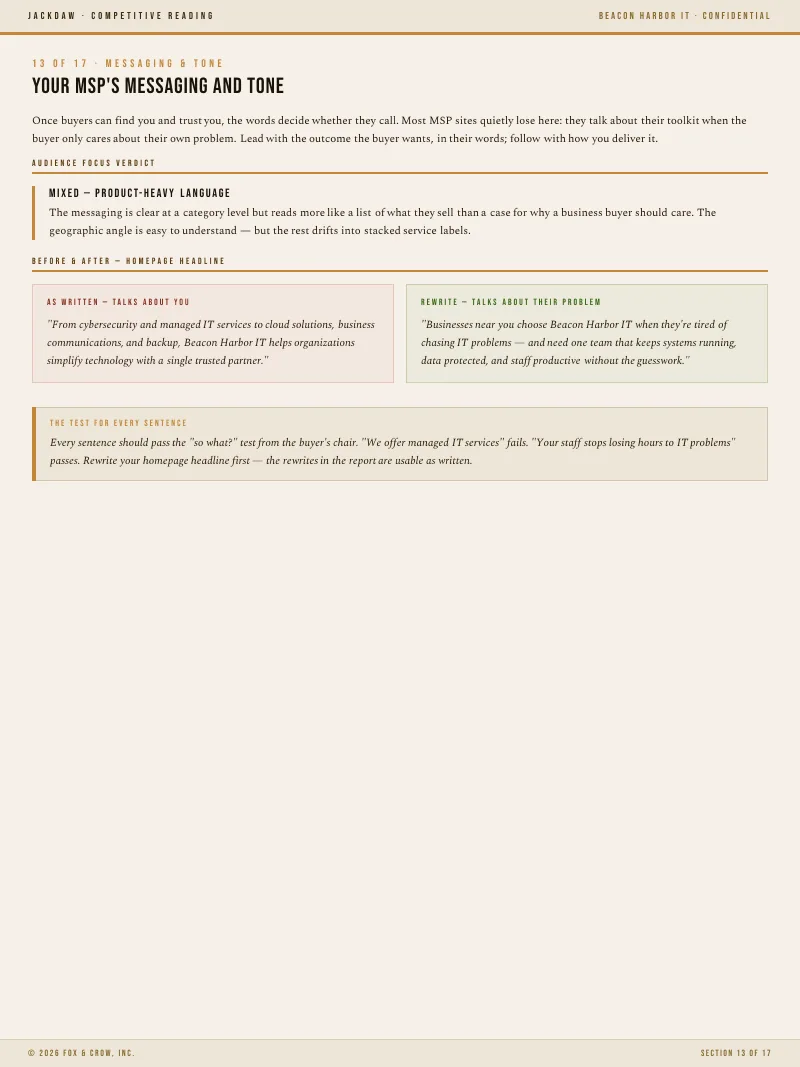
Jackdaw report page: Your Messaging and Tone
SECTION 13
From a real Jackdaw MSP report. Click to enlarge.

SECTION 14

Structured Data and AI-Search Readiness

What this section is
An audit of the embedded labels within the website's code that identify the business precisely to Google and AI systems: name, address, hours, and services. These labels are never visible to a human reader; automated systems rely on them exclusively. In practice, this markup takes the form of a small block of structured code (most commonly a format called JSON-LD) added to a page's HTML. It restates in a machine-readable format what a human visitor can already see: the business name, address, hours, and the specific services offered.
Why it matters
AI answer engines such as ChatGPT and Google's AI Overviews increasingly answer a query such as "which is a good MSP near me" directly, rather than presenting a list of links, and they construct these answers from clearly labeled websites. A properly labeled business can be cited directly as the answer. An unlabeled business is invisible to this entire channel. Almost no local MSP has completed this work at present, which gives an early adopter in a given market a real, and for now largely uncontested, advantage, though structured data is one input to these answers rather than a guarantee of being cited.
How to read yours
The audit identifies which labels the website currently carries and which are absent, together with the exact code required for each correction.
What to do with it

Turn this section into a single work order for whoever maintains the website, whether that is someone on your own team or an outside contractor. The corrections are inexpensive, largely permanent, and can be validated using the free tools identified in the report. If competitors exhibit the same gaps, confirmed in the comparison matrix, this represents an uncontested opportunity in the market.

Free Guide to MSP AI Search & Schema Markup: getting cited by ChatGPT and Google's AI Overviews, with copy-paste code and free validators.
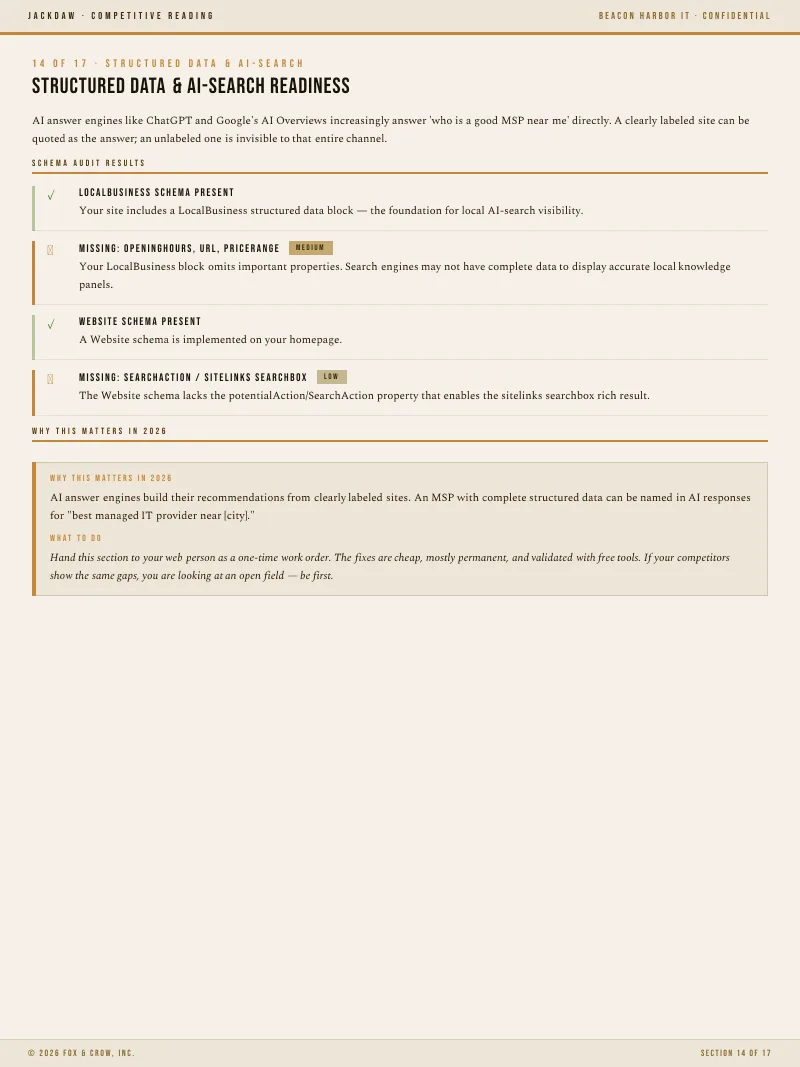
Jackdaw report page: Structured Data and AI-Search Readiness
SECTION 14
From a real Jackdaw MSP report. Click to enlarge.

SECTION 15

Your Project Plan

What this section is
Everything the report found, converted into a sequenced checklist: phases in order, each task tagged with impact, effort, and who should own it, paced to what your business can realistically take on.
Why it matters
A report that ends in insight still ends. This one ends in a work order. The sequencing matters: tasks are ordered by what each problem costs the business, so the plan front-loads the highest-impact work.
How to read yours
The phases are the order of operations. Impact tags tell you why each task made the list; effort tags and owner labels tell you what it takes and whose desk it lands on.
What to do with it

Put phase one on the calendar this week, with a name attached to each task. Work the phases in order and resist skipping ahead to whatever looks easiest. Check tasks off as you go; when the project plan is complete, run a new Jackdaw report and measure the change in your health score.

Free Guide to Planning Your MSP Marketing: how to sequence and staff the work yourself, without an agency.
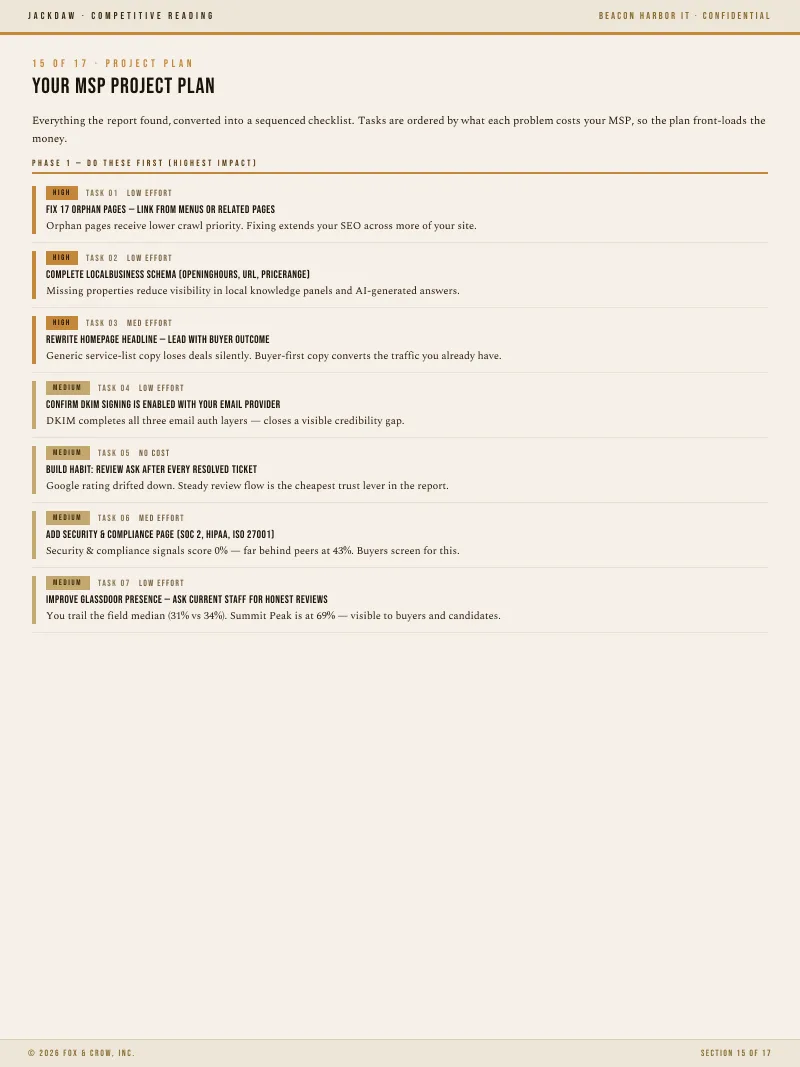
Jackdaw report page: Your Project Plan
SECTION 15
From a real Jackdaw MSP report. Click to enlarge.

SECTION 16

Appendix: The Technology We Detected
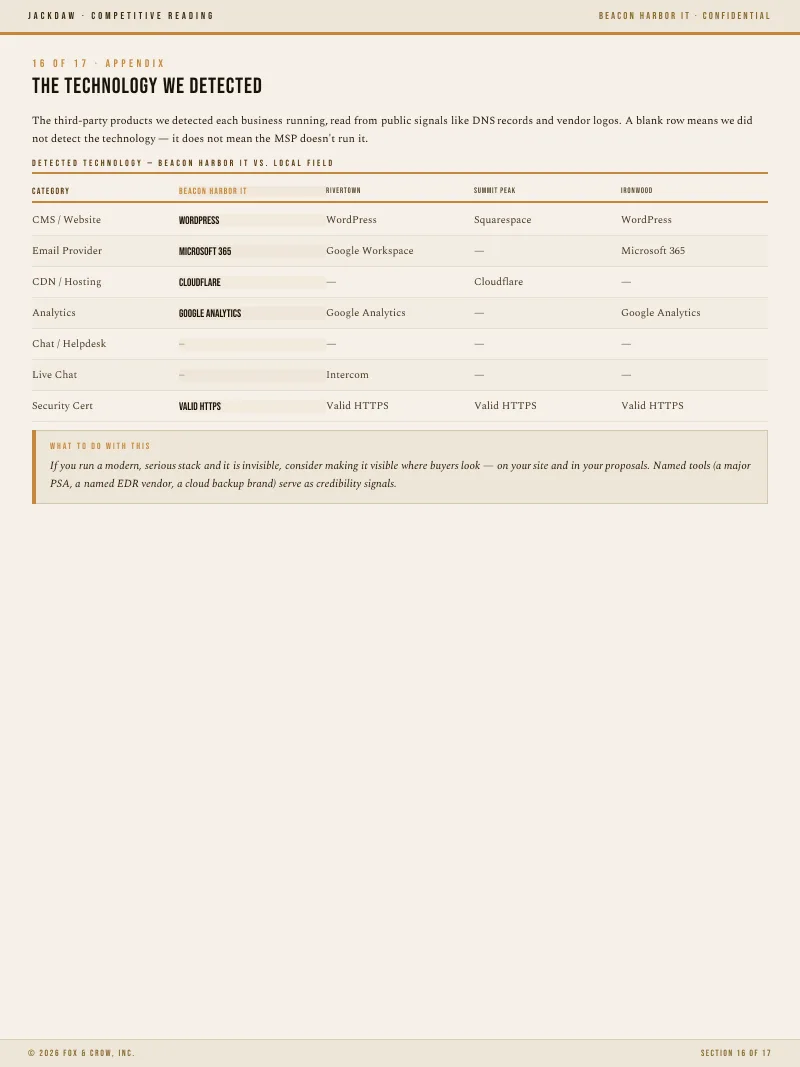
What this section is
The third-party products we detected each business running, read from public signals like DNS records and vendor logos. This is context, not a scorecard: detection only sees what is publicly visible, so a blank never proves a tool is absent.
Why it matters
Your visible stack is part of your credibility with informed buyers, and your rivals' visible stacks tell you how they are equipped. It also shows what your market can see about you without asking.
How to read yours
Check your own row first: is the stack you are proud of actually visible? Then scan rivals for context, holding the results loosely given the detection caveat.
What to do with it
If you run a modern, serious stack and it is invisible, consider making it visible where buyers look: on your site and in your proposals. Do not build sales arguments on a rival's blank row; build them on what the rest of the report proved.
Jackdaw report page: Appendix: The Technology We Detected
SECTION 16
From a real Jackdaw MSP report. Click to enlarge.

SECTION 17

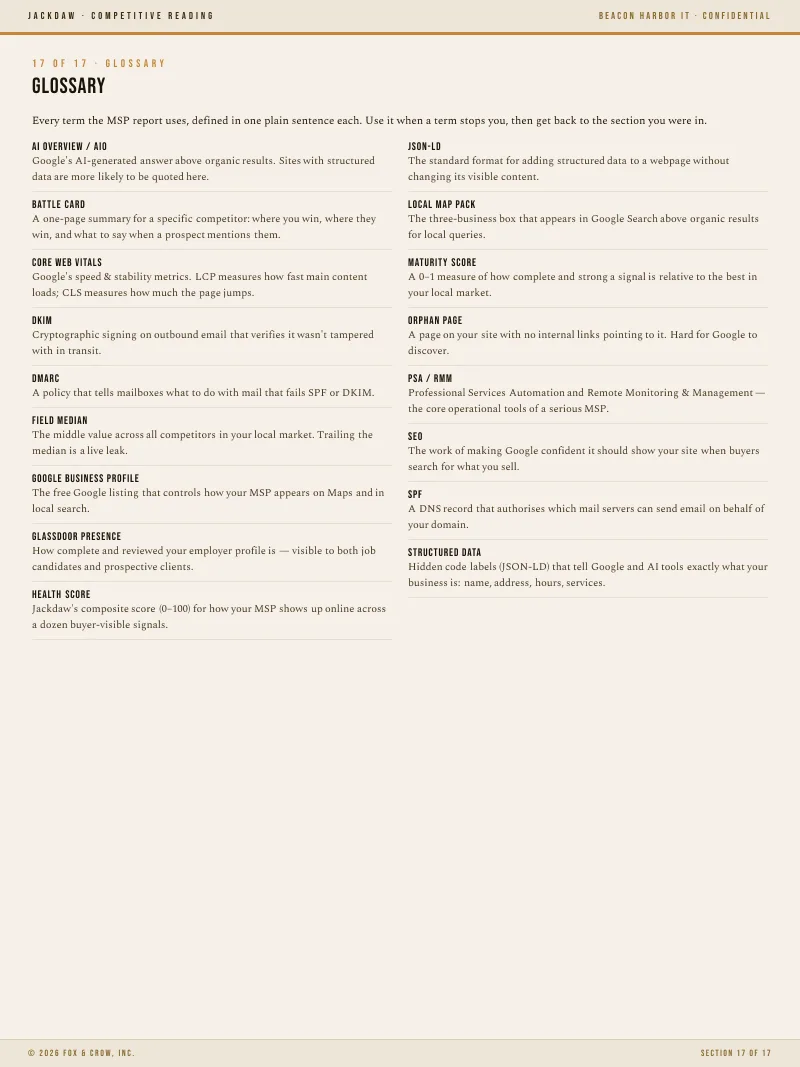
Glossary

What this section is
Every term the report uses, defined in one plain sentence each.
Why it matters
The report is written to avoid jargon, but some terms have no shorter name. The glossary means you never need a second tab open to finish reading.
How to read yours
Do not read it straight through. Use it when a term stops you, then return to the section you were in.
What to do with it
Share it with whoever on your team reads the report after you. It converts a lengthy explanation into none.
Jackdaw report page: Glossary
SECTION 17
From a real Jackdaw MSP report. Click to enlarge.

YOUR FIRST HOUR WITH THE REPORT

Here is the sequence that gets the most from the report in the least time.

01

Minutes 1 through 10: read the executive summary and the key takeaways. Note the closest rival by name.

02

Minutes 10 through 25: read the competitive scoreboard. Circle every measure where you trail the field median, and note any measure where one rival has run away from the pack.

03

Minutes 25 through 40: read the battle card for the rival you hear about most in real deals. Read the talk track out loud once.

04

Minutes 40 through 50: read the project plan. Put phase one on your calendar with a name on each task.

05

Minutes 50 through 60: send two emails. The SEO and structured data fixes go to your web person. The security items go to whoever runs your mail and hosting.

Everything else in the report rewards a slower read, but this hour puts the highest-cost findings in motion the same day the report arrives.

See what your market sees.

Your Jackdaw Report benchmarks your MSP against the competitors fighting you for the same customers, then hands you the plan. No retainer, no jargon. Book a meeting or call us at 517-243-3516 to order your Jackdaw Report. Ready to buy? Visit our payment portal below. Already have yours? Book a one-time deep-dive session. We walk through every section together, answer your questions, and help you prioritize your next moves.

Jackdaw is a product of Fox & Crow, a software company. We support you in understanding and applying your Jackdaw Report, and we can recommend trusted providers if you would rather have the work done for you. We do not sell marketing services or execution.

BUY YOUR JACKDAW REPORTBOOK A CALL517-243-3516